The U.S. Department of the Treasury’s Office of Foreign Assets Control (OFAC) announced on February 25th sanctions against Russian exploitation broker Sergei Zelenyuk and his St. Petersburg company Matrix LLC (also known as “Operation Zero”). They are accused of selling stolen U.S. government proprietary network tools, marking the first law enforcement case under the “Protecting American Intellectual Property Act” to target digital trade secrets theft.
Operation Zero’s Operations and Sanctioned Entities
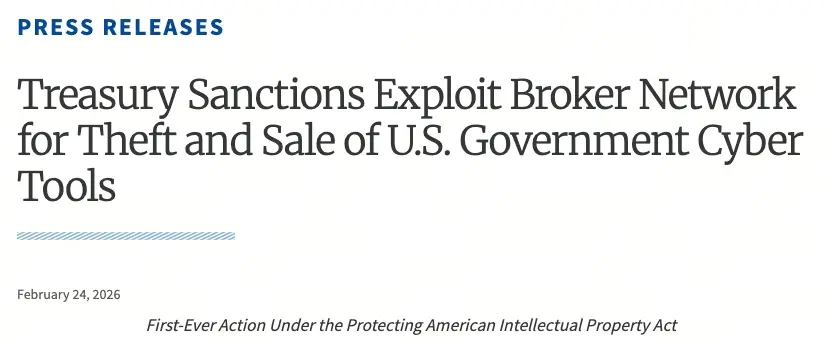
(Source: U.S. Department of the Treasury)
“Operation Zero” was launched in 2021, employing a public bounty system to purchase security vulnerabilities targeting mainstream operating systems and encrypted communication apps. Multiple bounties have been publicly posted on the X platform. Known rewards include $500,000 for 26 iOS vulnerabilities (November 2025) and $4 million for a complete attack chain vulnerability in Telegram (March 2025).
OFAC states that the exploits sold by “Operation Zero” enable attackers to gain unauthorized access, steal information, or remotely control targeted systems. The client base is explicitly limited to “private and government organizations in Russia,” focusing on offensive security research and software tools.
The sanctions also target two individuals: Oleg Vyacheslavovich Kucherov, suspected member of the Trickbot cybercriminal group, and Marina Evgenyevna Vasanovich, described as Zelenyuk’s assistant.
Australian Contractor Data Theft Case: $1.3 Million in Cryptocurrency as Key Evidence
The sanctions stem from investigations by the U.S. Department of Justice and FBI into Australian citizen Peter Williams. Williams, a former employee of a U.S. defense contractor, is accused of stealing eight “commercial secret zero-day exploits” between 2022 and 2025, selling them to “Operation Zero” for $1.3 million in cryptocurrency. Williams pleaded guilty in October 2025 to two counts of commercial secrets theft.
The U.S. State Department emphasized in an independent statement that the stolen tools were originally intended solely for sale to the U.S. government and its allies. Unauthorized resale poses a direct threat to U.S. intelligence capabilities. The Treasury also disclosed that “Operation Zero” is involved in developing espionage software and AI-driven tools to steal personal identification information, recruiting hackers via social media, and establishing contacts with foreign intelligence agencies.
Key Information on the Sanctions
Sanctioned Parties: Sergei Zelenyuk and Matrix LLC (“Operation Zero”), Kucherov, Vasanovich
Legal Basis: Protecting American Intellectual Property Act, marking its first application to digital trade secrets theft cases
Stolen Tools: Eight U.S. government proprietary network tools, originally intended for U.S. government and specific allies
Cryptocurrency Payments: Peter Williams sold stolen zero-day exploits for $1.3 million in cryptocurrency
Highest Bounty: “Operation Zero” previously offered a $4 million reward for a Telegram attack chain vulnerability
Frequently Asked Questions
What is the historical significance of the legal basis for these U.S. Treasury sanctions?
These sanctions are executed under the Protecting American Intellectual Property Act, which is the first time this law has been used to combat the theft and sale of digital trade secrets. OFAC states this signifies an expansion of U.S. enforcement tools against cyber tool theft into the realm of commercial secrets law, setting an important legal precedent.
What is “Operation Zero,” and how do their vulnerability trading operations work?
“Operation Zero” is a Russian exploitation broker led by Sergei Zelenyuk, purchasing security vulnerabilities for operating systems and encrypted communication apps through public bounties. Its clients are limited to Russian private and government organizations. The bounty rewards can reach up to $4 million, with transactions publicly posted on X, reflecting transparency in their dealings.
What implications does the use of cryptocurrency payments in this case have for crypto regulation?
Peter Williams paid $1.3 million in cryptocurrency to acquire stolen U.S. government zero-day exploits, highlighting cryptocurrency’s role as a primary payment method in transnational cyber espionage. This case raises regulatory concerns about the role of cryptocurrencies in national security crimes and underscores the importance of on-chain tracking tools and anti-money laundering measures in combating such transactions.
Disclaimer: The information on this page may come from third parties and does not represent the views or opinions of Gate. The content displayed on this page is for reference only and does not constitute any financial, investment, or legal advice. Gate does not guarantee the accuracy or completeness of the information and shall not be liable for any losses arising from the use of this information. Virtual asset investments carry high risks and are subject to significant price volatility. You may lose all of your invested principal. Please fully understand the relevant risks and make prudent decisions based on your own financial situation and risk tolerance. For details, please refer to
Disclaimer.
Related Articles
SEC Formally Recognizes XRP as Digital Commodity, Ripple Chief Legal Officer Confirms Long-Term Non-Security Status
Ripple Chief Legal Officer Stuart Alderoty welcomes the SEC's latest guidance, classifying XRP as a digital commodity rather than a security, ending regulatory disputes. The document provides a clear framework for the digital asset market, boosting market confidence, promoting long-term XRP adoption, and supporting the development of the Ripple ecosystem.
GateNews35m ago
SEC’s Paul Atkins Backs Crypto Safe Harbor for US Innovation
A proposed regulatory “safe harbor” for crypto firms in the U.S. aims to clarify rules for innovation and investor protection. It could offer temporary flexibility for projects to develop while ensuring transparency and compliance, addressing current regulatory uncertainties.
TodayqNews45m ago
US SEC and CFTC Join Forces to Release Major Guidance, Clarifying the Securities vs. Non-Securities Boundary for Crypto Assets
The U.S. Securities and Exchange Commission (SEC) released a 68-page document that systematically explains the applicability of federal securities laws to specific crypto assets, categorizing them into digital commodities, collectibles, utilities, stablecoins, and digital securities. The SEC emphasized that crypto assets are not necessarily securities and must be determined based on the definition of "investment contracts," while coordinating regulatory oversight with the Commodity Futures Trading Commission (CFTC) to establish clear market standards.
区块客58m ago
UK Reform Party Refuses to Disclose Crypto Wallet Address, Regulatory Gap May Amplify Political Funding Risk
The UK Reform Party has not yet provided cryptocurrency donation wallet addresses to the Electoral Commission, raising concerns about financial transparency and foreign interference. Regulators have pointed out that crypto donations present challenges in identity verification, calling for strengthened legislation to prevent illicit funds from flowing into the political system. As crypto asset financing expands, regulatory and compliance issues are becoming increasingly prominent.
GateNews1h ago
SEC and CFTC release new regulatory framework, raising challenges to the legislative necessity of the CLARITY Act
The U.S. SEC and CFTC jointly released a cryptocurrency asset regulatory framework proposing five categories of token classifications, clarifying regulatory responsibilities, and reducing market uncertainty. The framework highly overlaps with the CLARITY Act but still has issues with insufficient legal force and missing content in certain areas. The future legislative process remains to be observed.
GateNews1h ago
US Launches "BETS OFF Act" to Target War Prediction Markets, Insider Trading Concerns Surface
U.S. Congressional Democratic lawmakers have introduced the "BETS OFF Act," aimed at restricting predictive betting on wars and national security events to prevent speculation using sensitive information. The bill stems from unusual betting activities, with Senators Murphy and Representatives Casar emphasizing the ethical controversies and systemic loopholes in such conduct. If the bill advances, it will impact blockchain-based event trading models.
GateNews1h ago


