Author: Yuan Hong, Global Times
On February 26, the China National Computer Virus Emergency Response Center and other departments jointly released a new report illustrating how the United States leverages technological dominance to harvest virtual currency assets worldwide. According to incomplete statistics, from 2022 to 2025, the U.S. has confiscated over $30 billion worth of global virtual currency assets through various cases, with the Chen Zhi case alone accounting for $15 billion, representing 50%.
On the 26th, the China National Computer Virus Emergency Response Center, the National Engineering Laboratory for Computer Virus Prevention and Control Technology, 360 Digital Security Group, and Antiy Technology Group Co., Ltd. jointly published “The ‘Number One Player’—An In-Depth Analysis of the U.S. Technological Hegemony and Global Virtual Currency Asset Harvesting Operations.” The report, based on typical cases such as the Chen Zhi and Zhao Changpeng cases, explores the background of blockchain technology and security risks, systematically analyzes the process logic and technical details of how the U.S. exploits technological dominance to harvest virtual assets globally, and deeply deconstructs its national-level cyberattack methods and underlying political motives. It aims to provide references for countries worldwide to counter digital hegemony threats.
Du Zhenhua, senior engineer at the China National Computer Virus Emergency Response Center, explained the background of the report in an interview with Global Times: International organizations’ public data shows that as of the end of January 2026, the total market value of global virtual currency assets was approximately $2.73 trillion, with Bitcoin accounting for $1.57 trillion. Meanwhile, the gold reserves of central banks worldwide are about $5.83 trillion. “The market value of virtual currency assets has reached about 47% of the total official gold reserves globally, indicating that virtual assets have become an influential new financial asset.”
Against this backdrop, the U.S. government’s policy evolution on virtual currencies has shifted from initial neglect to gradual regulation, culminating in comprehensive legislation by 2025. “The latest report demonstrates that the U.S., leveraging its early technological advantages, industry concentration, comprehensive legal framework, and strong law enforcement, has built a ‘technological advantage—regulatory binding—agency enforcement’ integrated system. Using virtual assets as a key entry point, it employs cyberattacks, rule blockades, strategic patience, targeted harvesting, and offshore fishing to carry out precise and large-scale digital plunder, severely infringing on the technological sovereignty, economic interests, and political security of countries worldwide,” Du Zhenhua said.
The report reveals that the U.S. is the “top player” in this large-scale virtual currency “gambling” and has long held the “casino dealer” position. In the virtual asset domain, the U.S. controls core R&D rights of mainstream blockchain protocols, key node control, and on-chain data analysis advantages. Leading blockchain companies (such as Chainalysis and Elliptic) are dominated by the U.S., accounting for over 90% of the global on-chain tracing market. By utilizing its technological edge and rule-making authority, and with the cooperation of allied countries, the U.S. has integrated global virtual currency transactions into its regulatory and cross-border law enforcement systems through civil confiscation, criminal accountability, and fines, massively seizing overseas virtual assets.
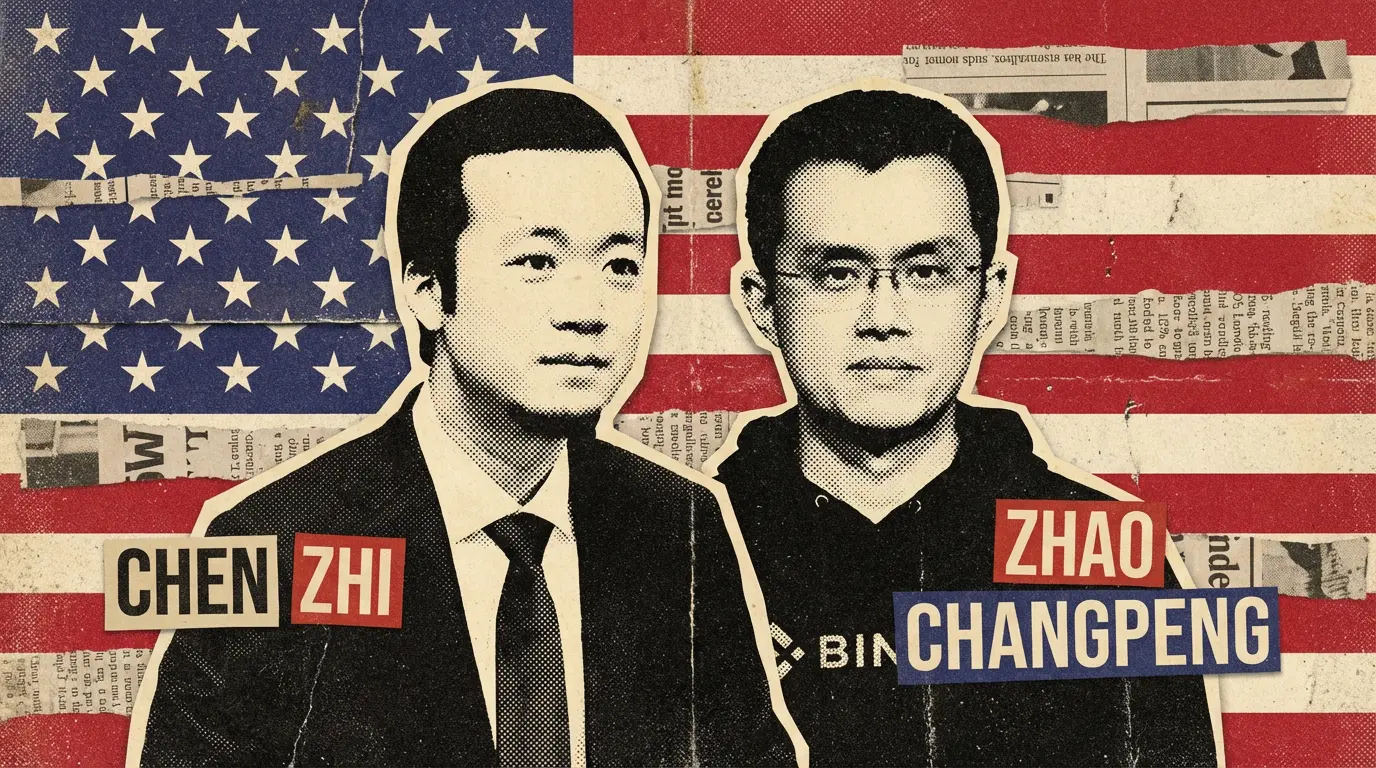
Chen Zhi and Zhao Changpeng Cases: The U.S. Profited Nearly $20 Billion from Two Major Cases
The Chen Zhi and Zhao Changpeng cases are two typical examples of the U.S. using technological hegemony to harvest global virtual assets. The report states that these cases fully demonstrate the “technological advantage—regulatory binding—agency enforcement” cycle, with clear hegemonic features in their process logic and technical details.
On January 7, the Ministry of Public Security repatriated Chen Zhi (a Chinese national), the leader of a major cross-border gambling and fraud syndicate, from Phnom Penh, Cambodia. Chen’s group is suspected of operating casinos, fraud, illegal business, and concealing criminal proceeds. Chen Zhi has been subject to compulsory measures according to law, and the case is under further investigation.
The report notes that in October 2025, the U.S. Eastern District of New York announced criminal charges against Chen Zhi, founder of the Cambodian Prince Group, involving telecom fraud and money laundering. It also announced the confiscation of approximately 127,000 bitcoins, valued at about $15 billion at the time, setting a record for the largest virtual asset seizure in U.S. judicial history.
The report states, “According to incomplete statistics, from 2022 to 2025, the U.S. has confiscated over $30 billion worth of global virtual currency assets through various cases, with the Chen Zhi case accounting for 50%.”
“From a geopolitical perspective, this operation is far more than just ‘law enforcement’ and cracking down on Southeast Asian scam networks. It exemplifies how the U.S., leveraging rule-making power, technical tracking advantages, and global intelligence networks, systematically and precisely harvests assets from potential competitors or gray-area forces. Under the banner of ‘protecting victims’ rights,’ the U.S. directly converts involved virtual assets into strategic financial reserves, completing a glamorous legal transfer from criminal chains to national assets,” said Zhou Hongyi, founder of 360 Group.
Zhou Hongyi commented that this unilateral harvesting by the U.S. not only disrupts other countries’ law enforcement efforts and causes secondary losses for victims but also interferes with the global flow of virtual assets, undermining financial stability in emerging markets. The ultimate goal is to consolidate U.S. dollar hegemony in digital finance.
The case of Binance and its founder Zhao Changpeng is another typical example of the U.S. using judicial hegemony and technical surveillance to force global virtual asset platforms to comply with its regulations, achieving economic extraction and rule export.
From 2023 to 2025, the U.S. launched “civil + criminal” dual accountability against Zhao Changpeng, resulting in Binance paying a $4.3 billion fine based on a plea agreement.
“During the investigation, the U.S. employed comprehensive technical monitoring to infiltrate Binance’s operational data, user data, and transaction data, demonstrating its technical superiority in monitoring digital asset platforms,” Du Zhenhua further explained. “The U.S. hacked into Binance’s internal servers, obtained core operational data and executive communications, and confirmed that Binance executives knowingly evaded U.S. regulatory compliance.”
Du Zhenhua analyzed that the enforcement logic of this case features a clear pattern of “rule preset—technical evidence collection—financial penalty,” meaning: the U.S. first extended its jurisdiction over global virtual asset platforms through domestic laws, then used technical means to gather violations, and finally imposed hefty fines to achieve economic extraction, while forcing the platform to undergo U.S.-style compliance reforms, thereby strengthening U.S. rule dominance in the virtual currency field.
He also added, “Throughout the enforcement process, for many scam victims, it was like a mantis catching a cicada, with the oriole behind. The U.S. allowed telecom fraud to flourish, and most of the huge profits obtained through technological hegemony were not returned to victims, effectively constituting an indirect plunder of foreign assets.”
U.S. Government Supports Hacker Groups in Targeted Attacks on Over 20 Virtual Currency Exchanges Worldwide
The report states that, as is well known, the U.S., as a true “Hacker Empire,” possesses the largest national-level hacking force globally. From 2023 to 2025, hacker groups supported by the U.S. government launched targeted attacks on over 20 major virtual currency exchanges worldwide, employing methods such as backdoors, spear-phishing, and supply chain infiltration, mainly stealing user wallet private keys, platform transaction logs, and compliance information. Targets spanned platforms across Asia, Europe, and Africa.
Xiao Xinguang, founder of Antiy Technology Group, analyzed, “From the timeline, some attacks appear related to enforcement actions by the U.S. Department of Justice, the U.S. Department of the Treasury’s Office of Foreign Assets Control (OFAC), and other agencies targeting the virtual asset sector.”
Xiao Xinguang noted that the U.S. has a long history of exploiting enforcement actions for profit in the virtual currency space. The famous Silk Road case is a typical example, where third-party assets were seized, auctioned, and transformed into U.S. government assets through enforcement and technical means. This has become a common method for the U.S. to seize global wealth and alleviate its own economic crises. Additionally, by controlling the regulation and transaction flow of virtual assets, the U.S. integrates the digital financial system into the dollar-led global financial architecture, preventing sanctioned or blocked countries from bypassing the dollar via virtual currencies, thus reinforcing its long-arm jurisdiction.
The report cites U.S. Department of Justice data showing that enforcement actions in the virtual asset sector can generate hundreds of millions of dollars annually, further increasing reliance on the dollar in global virtual currency trading and solidifying the dollar’s international monetary status.
“In fact, the Bitcoin auctioned and liquidated is just a tiny fraction of the U.S.'s outright seizure; most of it becomes strategic Bitcoin reserves. The U.S. aims to use control of ‘digital gold’ to hedge against the global de-dollarization trend. Its fundamental goal in harvesting global virtual assets through technological hegemony is to consolidate its economic dominance and the international status of the dollar,” Xiao Xinguang concluded.
The report summarizes that it systematically reveals the U.S. government’s malicious scheme to rely on technological hegemony, mask financial innovation, use virtual currency assets as a vehicle, maintain and upgrade dollar hegemony, and continue harvesting worldwide wealth.


