Market Prediction Polymarket recently launched the “2026 Taiwan Local Elections: Party Winners” trading pair. Currently, 88% of funds are betting that the Kuomintang will win the most seats in the county and city mayoral elections on November 28, while the Democratic Progressive Party (DPP) has only 12% support. However, the total trading volume of this market is less than $30,000.
(Background: Kalshi, a prediction market, cracks down on insider trading! MrBeast’s editor fined $20,000 and banned for two years; former California gubernatorial candidate receives a five-year ban)
(Additional context: The Netherlands bans Polymarket, deeming it illegal gambling. Prediction markets in Europe are facing setbacks.)
Table of Contents
Toggle
- $30,000 “public opinion” — just for reference?
- Settlement rules are based on seats, not votes
- Beware of legal issues when participating in prediction markets
- Derivative insider trading concerns
The 2024 U.S. presidential election made Polymarket highly popular, with a total trading volume of $3.68 billion and accurate result predictions, turning this decentralized prediction market into a mainstream media-favored alternative poll. Now, Taiwan’s election market has launched as scheduled.
$30,000 “public opinion” — just for reference?
According to Polymarket’s page, the current “2026 Taiwan Local Elections: Party Winners” market shows an 88% buy-in for the Kuomintang and 12% for the DPP. This seems overwhelming, but the total market trading volume is less than $30,000, with relatively few participants, possibly because the election is still far away.
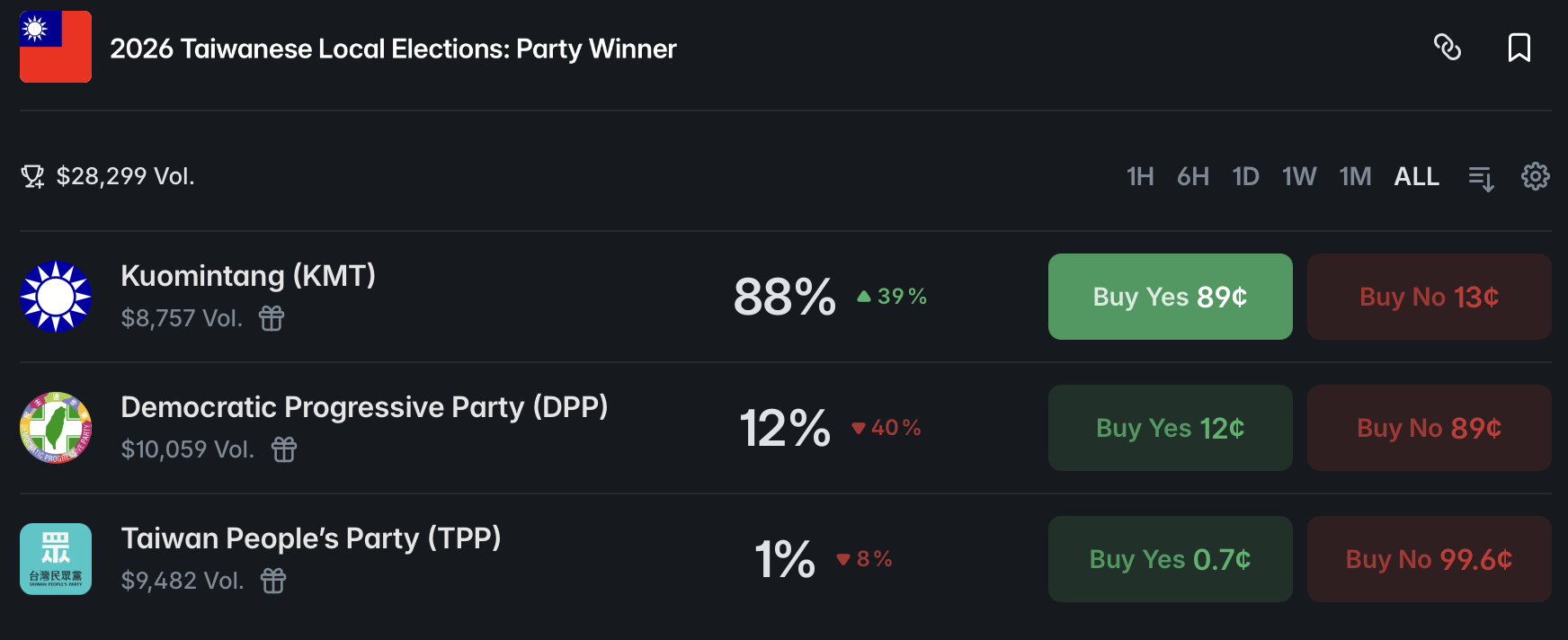
By comparison, Polymarket’s trading volume during the 2024 U.S. presidential election reached $3.68 billion (about NT$114.8 billion), a difference of five orders of magnitude. Under such liquidity conditions, just a few trades can significantly change odds. The so-called “88% win rate” is more like a reflection of a few people’s betting preferences rather than a prediction formed by collective money.
Settlement rules are based on seats, not votes
The settlement logic of this market is also noteworthy. According to Polymarket’s rules, the final result will be determined by which party’s official nominated candidate wins the most seats across Taiwan’s 22 county and city mayoral elections, not by total votes.
Independent candidates’ seats are not counted toward any party. In case of a tie, the winner will be decided based on the alphabetical order of the party’s English name, meaning KMT (Kuomintang) naturally ranks before DPP (Democratic Progressive Party).
Beware of legal issues when participating in prediction markets
For Taiwanese users, the biggest risk of participating in such markets is not losing money but violating election and recall laws. Polymarket has explicitly stated it does not open to Taiwanese users, but the permissionless nature of blockchain means technically participation is still possible.
However! Article 88-1 of Taiwan’s Civil Service Election and Recall Act states that using the internet to bet on election results can result in up to six months’ imprisonment, along with a fine of NT$100,000 to NT$1,000,000. Providing a venue or gathering people for betting can lead to up to five years’ imprisonment. The Taiwan High Prosecutors Office has also made it clear that election betting pools are illegal. Past cases and prosecutorial standards classify prediction markets as “gambling.”
During Taiwan’s 2023 presidential election, police mobilized over 70 officers nationwide to raid and arrest 17 users suspected of participating in election betting via Polymarket. Law enforcement traced on-chain transactions back to centralized exchange addresses and used KYC data to identify real identities. The anonymity of blockchain is far more fragile in legal proceedings than many think.
Derivative insider trading concerns
The compliance issues of prediction markets are not unique to Taiwan. Recently, U.S.-based prediction market Kalshi revealed its first insider trading cases: MrBeast’s editor was fined $20,000 and banned for two years for using non-public information to bet, and a former California gubernatorial candidate was sentenced to a five-year ban.
U.S. Democratic Congress members have also proposed the “2026 Financial Prediction Market Public Integrity Act,” aiming to prohibit elected officials and insiders from participating in “political” prediction market transactions. 
Disclaimer: The information on this page may come from third parties and does not represent the views or opinions of Gate. The content displayed on this page is for reference only and does not constitute any financial, investment, or legal advice. Gate does not guarantee the accuracy or completeness of the information and shall not be liable for any losses arising from the use of this information. Virtual asset investments carry high risks and are subject to significant price volatility. You may lose all of your invested principal. Please fully understand the relevant risks and make prudent decisions based on your own financial situation and risk tolerance. For details, please refer to
Disclaimer.
Related Articles
Prediction Market Trading Volume Expected to Exceed $1 Trillion by 2030, Bernstein Report Highlights
Bernstein's report forecasts prediction market trading volume will surge from $51 billion in 2025 to $1 trillion by 2030, driven by regulatory clarity, blockchain support, and mainstream integration. Industry revenue is expected to rise from $400 million to $10.8 billion, with retail brokerages gaining a competitive edge.
GateNews13m ago
Trader with 100% Win Rate Bets $12.3K That MicroStrategy Will Hold Over 1M BTC by Year-End
A trader known as epsteinfiles has placed a $12,300 bet with Lookonchain, predicting that MicroStrategy will hold over 1 million BTC by December 31, 2026, with a flawless track record in past bets.
GateNews9h ago
Encourage innovation! U.S. judges ban Arizona from regulating prediction markets, pausing the prosecution of Kalshi
A U.S. federal district court ruled that Arizona is barred from bringing charges against prediction market platform Kalshi under gambling laws, finding that the Federal Commodity Futures Trading Commission has exclusive jurisdiction. The ruling affects the boundary between state and federal authority in regulating financial markets. Kalshi, meanwhile, insists that its business falls under financial products rather than traditional gambling. Rulings by different states on prediction markets have varied, and the Trump family has also voiced support for prediction markets.
CryptoCity10h ago
21Shares 更新 Hyperliquid ETF 申請,揭露 THYP 代碼
21Shares updates its Hyperliquid ETF filing, confirming the stock ticker THYP, which is seen as an adjustment in response to SEC comments. This move increases the likelihood of the ETF being listed. Compared with Bitwise’s HYPE ETF, the latter has already announced a 0.67% management fee, one of the highest in the market. The Hyperliquid platform’s strong fundamentals attract attention, but given the uncertainty around inflows of meme-coin ETF funds, market demand still needs to be watched.
MarketWhisper10h ago
Major CEX Partners with High Roller Technologies to Enter Prediction Market Space
A major centralized exchange has partnered with High Roller Technologies to provide prediction market services in the U.S. Analysts project significant growth in this sector, although it faces regulatory challenges.
GateNews12h ago
Encourage innovation! A U.S. judge bans Arizona’s regulation of prediction markets and suspends the prosecution of Kalshi
A U.S. federal district court ruled that Arizona may not rely on its gambling law to prosecute the prediction market platform Kalshi, finding that the U.S. Commodity Futures Trading Commission has exclusive jurisdiction. The ruling affects the line between state and federal authority in financial market regulation, while Kalshi maintains that its business is a financial product rather than traditional gambling. Decisions by states on prediction markets have differed, and the Trump family has also expressed support for prediction markets.
CryptoCity13h ago


