The measures seek to fully integrate crypto exchanges into the established financial system and protect the identity information of the institution’s customers. The Central Bank states that this will promote “transparency, comparability, and predictability of information provided to the market.”
Brazil Issues Resolution Including Crypto Brokerages to Comply With Bank Secrecy Laws
Brazil is moving to integrate crypto exchanges into its financial ecosystem.
The National Monetary Council and the Central Bank of Brazil recently approved Resolution No. 5,280, which brings new compliance rules for virtual asset service providers in the country.
The resolution, which states that virtual asset service providers (VASPs) will be considered financial institutions under the Brazilian Bank Secrecy Act, seeks to establish an equivalent regulatory treatment for all exchanges operating in the local financial system and the mechanisms needed to protect it.
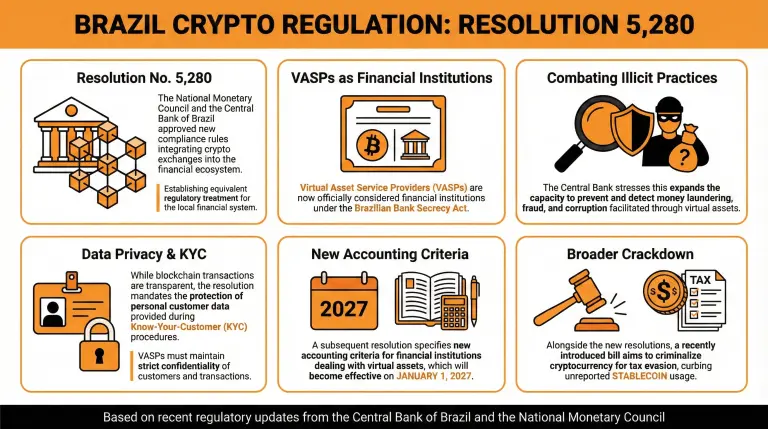
The Central Bank of Brazil stressed that this move “expands the capacity to prevent, detect, and combat illicit practices—such as money laundering, fraud, corruption, and other irregularities—that may be facilitated through the use of virtual assets.”
While blockchain transactions are transparent, given the nature of these structures, experts like Tiago Severo stressed that the identification and personal data of customers, provided when completing Know-Your-Customer (KYC) procedures, is what this resolution seeks to protect.
At the same time, it increases the responsibility of these institutions, which will have to take into account already established provisions regarding the confidentiality of their customers and their transactions.
In a subsequent resolution, the two institutions also approved a new resolution that specifies the accounting criteria that financial institutions dealing with virtual assets must follow.
The central bank states that regulatory clarity will contribute to investor confidence, assigning a clearer role to VASPs about the duties these institutions should fulfill.
The bank secrecy measure is already being applied, while the new accounting rules for financial institutions are set to become effective on January 1, 2027.
Recently, a bill criminalizing cryptocurrency for tax evasion was introduced into Congress, aiming to curb the usage of stablecoins for unreported payments and transactions.
FAQ
- What recent resolution has Brazil approved regarding crypto exchanges?
Brazil approved Resolution No. 5,280, integrating crypto exchanges into its financial ecosystem as virtual asset service providers.
- How does Resolution No. 5,280 affect virtual asset service providers (VASPs)?
VASPs will now be classified as financial institutions under the Brazilian Bank Secrecy Act, requiring compliance with new regulations.
- What is the goal of this regulatory change by the Central Bank of Brazil?
The aim is to enhance the detection and prevention of illicit practices, including money laundering and fraud, associated with virtual assets.
- When will the new accounting rules for financial institutions dealing with virtual assets take effect?
The new accounting criteria for financial institutions will become effective on January 1, 2027.
Disclaimer: The information on this page may come from third parties and does not represent the views or opinions of Gate. The content displayed on this page is for reference only and does not constitute any financial, investment, or legal advice. Gate does not guarantee the accuracy or completeness of the information and shall not be liable for any losses arising from the use of this information. Virtual asset investments carry high risks and are subject to significant price volatility. You may lose all of your invested principal. Please fully understand the relevant risks and make prudent decisions based on your own financial situation and risk tolerance. For details, please refer to
Disclaimer.
Related Articles
Japan Stablecoin Regulations: Full Breakdown—From Fund Settlement to JPYC Launch, Understand Three Compliant Issuance Paths at a Glance
Japan is one of the major economies to establish a comprehensive legal framework for stablecoins at the earliest stage in the world. With the formal implementation of the 2023 amendments to the Act on Payment Services (amended Funds Settlement Act), the issuance of yen stablecoins has moved from a legal gray area to clear regulation, and in 2025 it will see the official launch of the first compliant yen stablecoin, JPYC. This article fully reviews the development of Japan’s stablecoin regulations, three compliant issuance pathways, and the main current market cases, so that financial institutions in Taiwan and the crypto industry can use it as a reference.
Background of Japan’s stablecoin legislation: From the UST collapse to regulatory formation
In May 2022, the algorithmic stablecoin TerraUSD (UST) collapsed, triggering intense global attention on stablecoin regulation. Japan then accelerated its legislative efforts; in June of the same year, Japan’s National Diet formally passed a stablecoin bill, clearly defining stablecoins as those that must be linked to fiat currency, and that must be
ChainNewsAbmedia15m ago
Sports betting contracts are derivatives! The U.S. CFTC blocks local law enforcement and seeks regulatory control over prediction markets
The U.S. federal government is working together with the CFTC and the Department of Justice to try to shift regulatory authority for Kalshi prediction markets from local governments to the federal level, arguing that sports event contracts are financial derivatives. If the court supports this position, it will change the legal status of prediction markets and provide uniform national regulation, reducing the influence of state-level gambling laws.
CryptoCity20m ago
Argentina Recognizes Crypto as Qualified Investors' Net Worth
Argentina's CNV now counts cryptocurrencies as assets for qualifying investors, enabling access to the $479K threshold. Although a 2022 ban restricts retail crypto services, banks are exploring blockchain, with potential policy changes anticipated under President Milei.
Coinpedia35m ago
Ruling sports betting contracts are derivatives! The U.S. CFTC blocks local enforcement efforts and pushes to take regulatory control of prediction markets
The U.S. federal government is working together with the CFTC and the Department of Justice to try to shift regulatory authority over Kalshi’s prediction markets from state and local governments to the federal level, arguing that sports-event contracts are financial derivatives. If the court supports this position, it will change the legal status of prediction markets and standardize regulation nationwide, reducing the influence of local gambling laws.
CryptoCity3h ago
Tether-linked Super PAC’s first $300,000 spending went to a company co-founded by the CEO, allegedly involving pay-to-play and favoritism.
A super political action committee affiliated with Tether filed paperwork with the U.S. Federal Election Commission showing that its first $300k expenditure went to Nxum Group, founded by Tether U.S. CEO Bo Hines, to buy campaign ads for Georgia Republican candidate Clay Fuller, raising questions about pay-to-play.
GateNews4h ago


