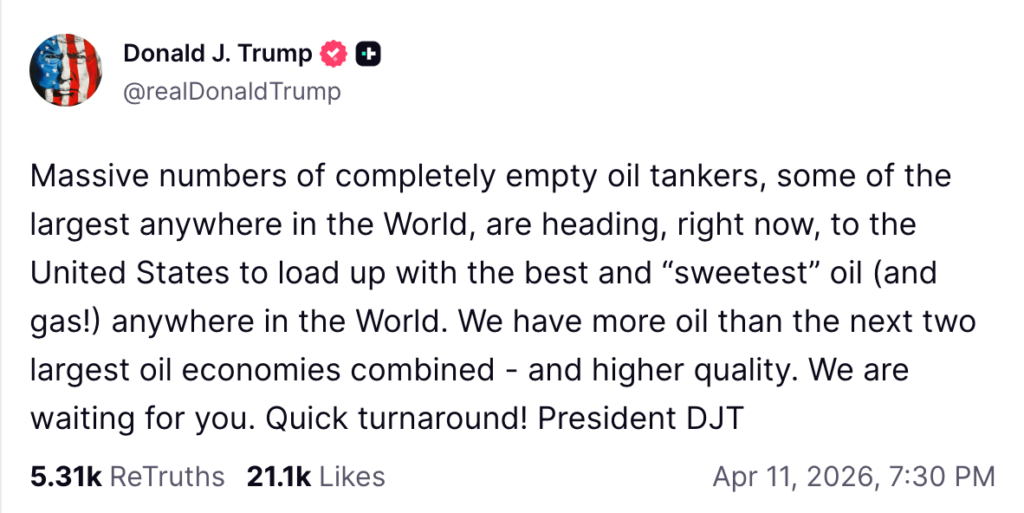
Trump said in a post on Truth Social on the 11th that a large number of fully empty large oil tankers are heading toward the United States, preparing to load the sweetest (with a lower sulfur content) crude oil from the U.S. Behind this is market behavior in which global buyers have accelerated their search for alternative supply after geopolitical risks in the Strait of Hormuz have heated up.
(Background recap: The U.S.-Iran negotiations declared a breakdown after 21 hours! Vance: Iran refuses a permanent nuclear abandonment commitment; Bitcoin quickly drops sharply)
(Additional background: Bloomberg: The impact of a U.S.-Iran war on Bitcoin is limited; it’s trading in a range of $60k to $70k; Hyperliquid contracts are the go-to risk-hedging barometer)
U.S. President Trump posted on Truth Social earlier, claiming that a large number of “fully empty” large oil tankers are rushing at full speed toward the United States, preparing to load U.S. oil and natural gas.
The oil reserves we have are even more than the two largest oil economies behind us combined, and the quality is better.
We’re waiting for you. Turnaround is extremely fast!
Energy market analysts point out that the massive rerouting of VLCC routes to the U.S. Gulf Coast is not just political propaganda—it’s actually happening. Multiple empty-loaded VLCCs are on their way across the ocean. VLCC (Very Large Crude Carrier) is the largest tanker type by global tonnage; a single vessel can carry about 2 million barrels of crude oil and is typically used for long-distance intercontinental transportation.
Why is sweet crude favored?
In the post, Trump specifically emphasized that U.S. oil is the “sweetest,” which has a clear meaning in the industry.
Sweet crude refers to crude oil with a lower sulfur content. Represented by U.S. WTI and shale oil, the sulfur content is typically below 0.5%, resulting in lower refining costs and a higher yield rate of refined products. Over the long term, it has been the top choice for refineries worldwide.
By contrast, in the Middle East, most oil-producing countries’ crude is “sour crude,” which requires more refining steps to reach the same level of quality.
Since the shale gas revolution, the U.S. has in recent years become the world’s largest crude oil producer, with daily output surpassing 13 million barrels, and it does have structural advantages in refining quality.
The geopolitical implications of stability in the oil market
From a macro market perspective, if U.S. energy exports rise significantly, it could divert some reliance on Middle East oil, reducing the marginal impact of any Hormuz Strait blockade. In turn, the geopolitical risk premium in oil prices may move toward easing.
Meanwhile, oil price stability often helps stabilize global risk-asset sentiment. After all, during this round of heightened U.S.-Iran tensions, Bitcoin has repeatedly seen sharp volatility, and the direction of absorbing the geopolitical premium is an important variable to watch for what comes next in the crypto market.

Disclaimer: The information on this page may come from third parties and does not represent the views or opinions of Gate. The content displayed on this page is for reference only and does not constitute any financial, investment, or legal advice. Gate does not guarantee the accuracy or completeness of the information and shall not be liable for any losses arising from the use of this information. Virtual asset investments carry high risks and are subject to significant price volatility. You may lose all of your invested principal. Please fully understand the relevant risks and make prudent decisions based on your own financial situation and risk tolerance. For details, please refer to
Disclaimer.
Related Articles
The Hong Kong Innovation and Technology Bureau signed a memorandum of cooperation with the National Cyberspace Administration of China, covering areas including AI, cross-border data flows, and blockchain.
Gate News message. On April 13, the Innovation, Technology and Industry Bureau of the Hong Kong Special Administrative Region Government announced that it has signed with the National Internet Information Office a Memorandum of Understanding on Cooperation for the Development of Innovation and Technology, with the aim of promoting high-quality development of the digital economy empowered by technological innovation. The Memorandum of Understanding covers key areas such as artificial intelligence, cross-border data, and blockchain. The objective of the Memorandum of Understanding is to further implement the country’s national “15th Five-Year Plan”, support Hong Kong in building an international innovation and technology center, and promote the development of a new real-economy led by technological innovation.
GateNews35m ago
The U.S. military announced a blockade in waters east of the Strait of Hormuz, and all vessels must obtain authorization to pass through.
Gate News update. On April 13, a notice to seafarers showed that the U.S. military announced it will impose a blockade in the Arabian Sea and the Gulf of Oman east of the Strait of Hormuz. According to the notice, any vessel that enters or leaves the blockade area without authorization will be intercepted, diverted, and detained. The blockade measure applies to all maritime traffic, regardless of the flag the vessel flies.
GateNews35m ago
Israeli Prime Minister Netanyahu says the Iran ceasefire could end soon
Gate News message: On April 13, Israel’s Channel 12 reported that Prime Minister Benjamin Netanyahu said today that a ceasefire with Iran may end very soon.
GateNews52m ago
Bitcoin analysts flag triggers for a massive surge to $88,000 even as war risks linger
Key factors, such as ETF flows, macro factors and on-chain supply favor a rally in bitcoin even as war risks linger.
CoinDesk2h ago
Bitcoin analysts flag triggers for a massive surge to $88,000 even as war risks linger
Key factors, such as ETF flows, macro factors and on-chain supply favor a rally in bitcoin even as war risks linger.
CoinDesk2h ago
Bitcoin analysts flag triggers for a massive surge to $88,000 even as war risks linger
Key factors, such as ETF flows, macro factors and on-chain supply favor a rally in bitcoin even as war risks linger.
CoinDesk4h ago


