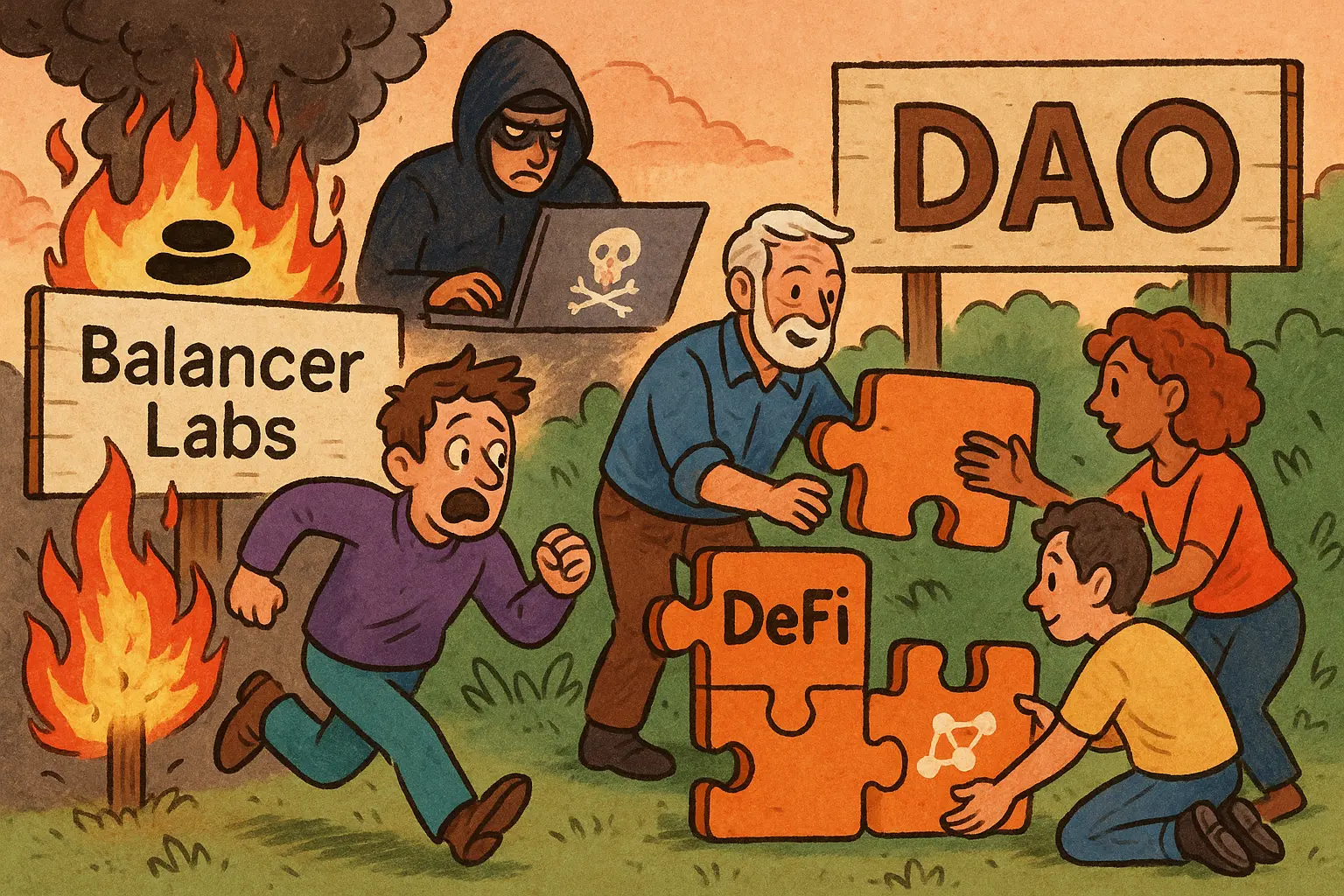
DeFi Protocol Balancer’s developer company, Balancer Labs, announced its closure last November, about four months after suffering a $116 million vulnerability attack. The protocol itself will continue to operate, with governance and operational functions transferred to the Balancer Foundation and DAO in the future. DAO members have been asked to vote on two restructuring proposals.
Dual Reasons for Balancer Labs Closure: Financial Imbalance and Legal Risks
Balancer Labs CEO Marcus Hardt pointed out that the company has long spent excessively on liquidity incentives, resulting in a severe imbalance between costs and actual protocol revenue. The cost structure’s price is the ongoing dilution of BAL token holders’ interests.
Martinelli added that the November exploit “created real and ongoing legal risks.” Maintaining a corporate entity after the incident to bear unresolved security liabilities is no longer financially feasible. Notably, he also mentioned that Balancer has generated over $1 million in actual revenue in the past three months, indicating that the core functionality of the protocol still has a sustainable foundation. “The issue isn’t that Balancer can’t be used, but that its economic model is flawed. These issues are solvable,” he said.
Four-Year Collapse of Balancer TVL: From $3.3 Billion to $158 Million
- November 2021: TVL peaks at $3.3 billion, making Balancer one of the most representative DeFi protocols during the bull market.
- October 2025: TVL drops to $800 million, with long-term liquidity continuing to flow out.
- Two weeks after the November 2025 hacker incident: TVL further shrinks by about $500 million, with the security breach causing immediate damage to user confidence.
- Current: TVL has fallen to approximately $158 million, a decline of over 95% from the peak.
This trajectory clearly illustrates the systemic difficulties DeFi protocols face in recovering liquidity after large-scale hacking incidents, providing the core background for Balancer Labs’ ultimate decision to close rather than continue draining resources.
DAO Takeover Plan: Streamlined Continuation and Tokenomics Restructuring
Martinelli proposed a “more streamlined continuation path,” including reducing BAL token issuance to zero, restructuring fee models to increase protocol revenue for the DAO, minimizing team size, and significantly cutting operational costs.
Hardt stated, “Balancer still has enormous growth potential. If we can successfully complete the transition, we have the opportunity to build a stronger, more sustainable protocol.” Currently, DAO members have been asked to vote on two proposals, one involving restructuring Balancer’s operational framework and the other regarding potential adjustments to the BAL token economic model.
Frequently Asked Questions
Q: Does the closure of Balancer Labs mean the protocol will also cease operation?
A: No. Balancer Labs’ closure pertains to the corporate entity, not the protocol itself. Martinelli and Hardt plan to transfer governance and operational functions to the Balancer Foundation and DAO, allowing the protocol to continue operating under a leaner structure.
Q: What are the subsequent impacts of the $116 million vulnerability attack in November on Balancer?
A: Besides the direct loss of $116 million, the attack triggered real and ongoing legal risks, and within two weeks, TVL decreased by about $500 million. This chain reaction caused Balancer’s TVL to fall from a peak of $3.3 billion to the current approximately $158 million, a reduction of over 95%.
Q: How will the restructuring affect BAL token holders?
A: The proposals include reducing BAL token issuance to zero and restructuring fee models to increase DAO revenue. This means that liquidity incentives that previously diluted holder interests will be significantly reduced. However, the specific plan will only be implemented after DAO approval through voting.
Disclaimer: The information on this page may come from third parties and does not represent the views or opinions of Gate. The content displayed on this page is for reference only and does not constitute any financial, investment, or legal advice. Gate does not guarantee the accuracy or completeness of the information and shall not be liable for any losses arising from the use of this information. Virtual asset investments carry high risks and are subject to significant price volatility. You may lose all of your invested principal. Please fully understand the relevant risks and make prudent decisions based on your own financial situation and risk tolerance. For details, please refer to
Disclaimer.
Related Articles
Aave Proposes 25,000 ETH for DeFi United Kelp DAO Relief
Aave service providers put forth a governance proposal on Friday that would contribute 25,000 ETH worth nearly $58 million from the protocol's DAO to DeFi United, a coordinated relief effort to restore backing for rsETH following last week's Kelp DAO exploit. The proposed contribution would
CryptoFrontier2h ago
XRP Breakout Holds as XRPL Lending Vote Gains Momentum
Key Insights
XRP maintains weekly strength above major cryptocurrencies as price holds above key EMAs, reflecting sustained momentum despite minor daily declines in trading sessions.
XRPL validators advance lending upgrades through XLS-65 and XLS-66, introducing pooled liquidity vaults and f
CryptoNewsLand2h ago
XRP Breakout Holds as XRPL Lending Vote Gains Momentum
XRP shows weekly strength, trading above EMAs after breaking from a descending wedge; XRPL advances XLS-65/66 lending upgrades with pooled vaults and fixed-term loans; derivatives rise in volume, open interest, and options activity.
Abstract: This report notes XRP's persistent weekly momentum and price strength above key moving averages following a breakout from a descending wedge. It covers XRPL validators voting on XLS-65 and XLS-66, enabling native lending, pooled liquidity vaults, and fixed-term loans to expand on-chain financial activity. It also reports rising derivatives participation, with higher trading volume, open interest, and a surge in options activity, suggesting increasing trader positioning for a continued breakout.
CryptoNewsLand2h ago
Charles Hoskinson Launches Midnight With $250M in Tokenized Deposits From Monument Bank
Gate News message, April 25 — Charles Hoskinson, founder of Cardano, has launched Midnight, a privacy-focused blockchain project, with approximately $250 million in tokenized deposits from Monument Bank. The partnership represents a significant institutional collaboration aimed at integrating blockc
GateNews5h ago
JPMorgan ETF Trend Report: API-ification, Active Management at 83%, Tokenization Split into Two Paths—Synthetic and Native
JPMorgan Chase’s report highlights three major trends: 1) AP’s API automated trading accounts for about 50% of top-tier market traffic; 2) in 2025, actively managed ETFs make up 83% of new issuance, and are expected to become mainstream in 2026–27; 3) tokenization splits into two paths: synthetic (mirroring prices through derivatives) and native (issued on the blockchain). The report emphasizes improving transparency and governance with tools such as Athena, and monitors subsequent follow-through and the timeline toward formal productization.
ChainNewsAbmedia6h ago
Drift Product Lead Minh Don Plans Relaunch of Forked Exchange in May or June
Gate News message, April 25 — Drift Protocol's product lead Minh Don announced plans to relaunch the forked exchange in May or June, according to a statement made on the official Discord server. The team will spend several weeks optimizing the codebase, removing and adding features that, while
GateNews6h ago


