A new prototype from Lightning Labs CTO Olaoluwa Osuntokun could help bitcoin users recover funds if quantum threats force drastic network changes. The tool addresses a key risk in proposed emergency upgrades.
Key Takeaways:
- Lightning Labs CTO Olaoluwa Osuntokun built a prototype to secure bitcoin wallets from quantum risk.
- Tests show <1 min proof time and 1.7MB size, offering scalable recovery for Bitcoin users.
- BIP-360 gains urgency as quantum threat debate grows, with adoption possible in next few years.
New Tool Aims to Save Bitcoin Wallets From Quantum Threat
A senior bitcoin developer has introduced a prototype designed to solve a long-standing problem: how to protect users if the network ever faces a quantum computing threat.
Olaoluwa Osuntokun, Chief Technology Officer at Lightning Labs, has built a working system that could allow users to recover funds from vulnerable wallets. The tool comes as developers continue to debate how bitcoin should respond to future advances in quantum computing.
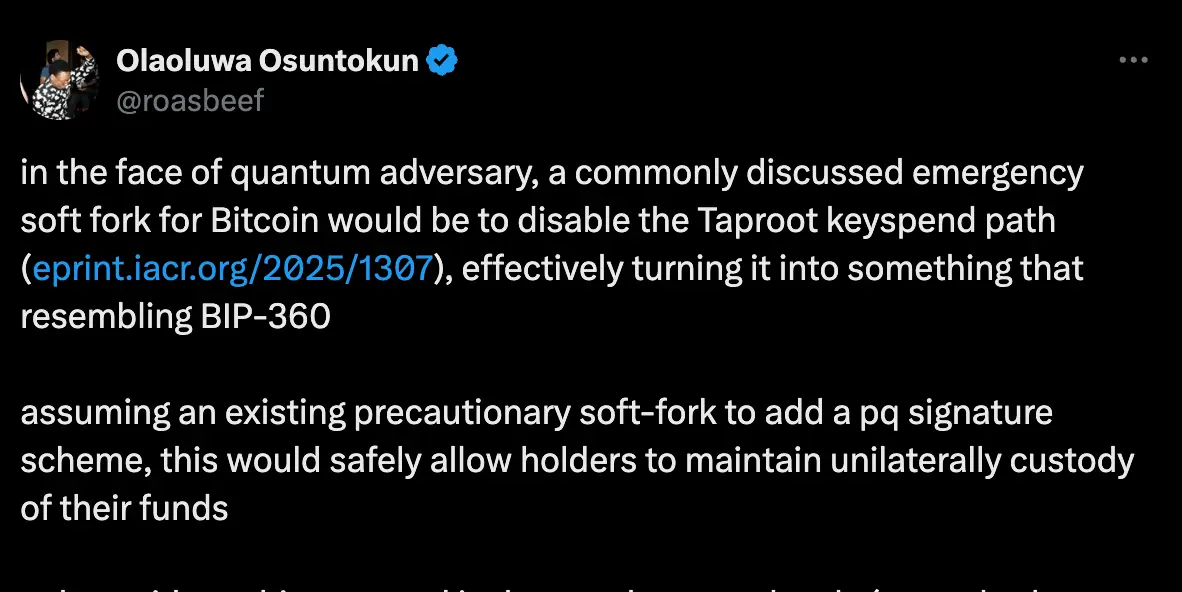
Bitcoin’s security relies on cryptographic signatures. In theory, powerful quantum machines could break these signatures and expose private keys. To prepare, developers have proposed upgrades such as BIP-360, which introduces quantum-resistant wallet structures.
However, migrating funds to new wallets would take time, as not all users would act quickly. That creates a risk if the network adopts an emergency measure, often called an “emergency brake,” which would disable existing signature methods to prevent attacks. Such a move could secure the network but also leave many users locked out of their own wallets.
Osuntokun’s prototype addresses this gap. Instead of relying on signatures, the system allows users to prove ownership using their wallet’s original seed phrase. It does so without revealing the seed itself, preserving security across related wallets.
The approach uses zero-knowledge proofs. In simple terms, users can demonstrate that a wallet was derived from their secret key without exposing it. This creates an alternative path to move funds if traditional methods are no longer available.
The prototype is already functional. Tests show that generating a proof takes under a minute on consumer hardware, while verification takes seconds. The proof file is about 1.7 megabytes in size.
Despite this progress, the tool has no formal proposal for inclusion in bitcoin’s codebase with no timeline for adoption. The broader question remains unresolved. Some researchers argue that practical quantum attacks are still distant. Others believe preparation must happen now to avoid systemic risk.
Market sentiment reflects this uncertainty. Prediction markets suggest a moderate chance that quantum-resistant upgrades like BIP-360 could be implemented within the next few years.
For now, Osuntokun’s work stands as a proof of concept. It demonstrates that a technical solution exists to balance security with user access. If quantum threats ever become real, such tools could play a critical role in ensuring that protecting the network does not come at the cost of freezing user funds.
Disclaimer: The information on this page may come from third parties and does not represent the views or opinions of Gate. The content displayed on this page is for reference only and does not constitute any financial, investment, or legal advice. Gate does not guarantee the accuracy or completeness of the information and shall not be liable for any losses arising from the use of this information. Virtual asset investments carry high risks and are subject to significant price volatility. You may lose all of your invested principal. Please fully understand the relevant risks and make prudent decisions based on your own financial situation and risk tolerance. For details, please refer to
Disclaimer.
Related Articles
Bitcoin Dominance Approaches 59.9% Resistance, Altseason Signals Emerge
Bitcoin dominance has reached 59.9%, nearing a key resistance level. If rejected, analysts predict a capital shift to altcoins, potentially leading to an "altseason," as past trends show this often initiates rallies in smaller assets.
GateNewsJust Now
BTC breaks through 75000 USDT
Gate News bot message, Gate market shows that BTC has broken through 75000 USDT, with the current price at 75007.8 USDT.
CryptoRadar12m ago
Stablecoin Liquidity Surge Signals Potential Bitcoin Rally, Analyst Says
Tether's market cap has increased by $40 million, reaching $187 billion, and recent stablecoin circulation has added $3 billion. This reflects improved liquidity conditions, potentially signaling a price rally for Bitcoin if the trend continues.
GateNews16m ago
BTC rises 0.58% in 15 minutes: whale large-capital transfers and derivatives defensive positioning drive spot buying
2026-04-20 06:30 to 2026-04-20 06:45 (UTC), the BTC price recorded a +0.58% return rate. The candlestick range was 74347.7 to 74898.0 USDT, with an amplitude of 0.74%. During this period, market attention increased because large orders and on-chain capital flow showed abnormal fluctuations, resulting in a higher overall volatility.
The main driver behind this anomalous move is whale entities concentrating large withdrawals and transfers targeting exchanges. Over the past 24 hours, the total reached 3,824 BTC, directly reducing the exchange’s BTC liquidity and bringing increased buy pressure to the spot market. On-chain data shows that the value of large transfers per transaction exceeding 1 million US dollars rose significantly during this window. As exchange immediate liquidity contracted, it pushed the BTC price upward in the short term. In addition, the derivatives market’s positioning structure changed: total futures open interest (OI) fell, and some defensive options positions shifted toward spot buying, further strengthening upside momentum.
Second, overall market liquidity remains in a fragile range. Order book data shows that large market buy orders were heavily concentrated, and buy-side depth increased noticeably. Meanwhile, in the same period, market Mempool activity and on-chain transaction fees were at low levels, and trading activity declined—making the impact of large single transfers and buy orders on price more pronounced. At the same time, leveraged funds leaving the derivatives market and options’ “maximum pain” strike price being below the spot price increased the spot market’s sensitivity to volatility. With multiple factors converging, the short-term upward price impulse was amplified.
Currently, market liquidity risk is rising, and in the short term the price is dominated by large buy orders in the order book and on-chain whale liquidity. Traders should continue to monitor the direction of whale capital flows and changes in exchange reserves, and be alert to possible price pullbacks caused by capital returning. At the same time, the key support range (72,000–74,000 USDT), order book depth, and derivatives positioning structure remain the core monitoring indicators for near-term volatility. Investors should be mindful of the risks stemming from fragile short-term liquidity and keep an eye on more real-time market developments.
GateNews45m ago
Musk’s X introduces smart tags, driving $1 billion in global trading volume in 3 days
Musk’s social platform X rolled out a brand-new “Smart Cashtags” feature on the evening of April 15 (last Tuesday). On April 17, Nikita Bier, X’s product lead, announced that in just 3 days the feature drove about $1 billion in trading volume across global markets, based on aggregated data from X’s trading pilot program.
MarketWhisper1h ago


