Opinion by: Alex Tsepaev, chief strategy officer at B2PRIME Group.
Each generation has its own distinct characteristics, even when it comes to investing. Younger people, for example, show a higher tolerance for risk. More than 64% of Gen Z and 49% of millennials say they are willing to take on more of it.
That appetite naturally includes investing in cryptocurrencies, which is considered one of the riskiest asset classes in modern markets. No surprise, then, that nearly two-thirds of Gen Zs plan to invest in cryptocurrencies like Bitcoin this year. Even more striking is that they are almost four times as likely to own crypto as to own a retirement account.
This might look like pure speculation. These numbers suggest that something more structural is happening.
For Gen Z, crypto is becoming an important part of their portfolios. The question now is whether that bet is mature or premature.
Volatility is the price of admission
Although it is arguable, crypto volatility remains one of the biggest obstacles in investing. Prices can change every millisecond, and trading happens around the clock. This has a significant effect on the final execution price.
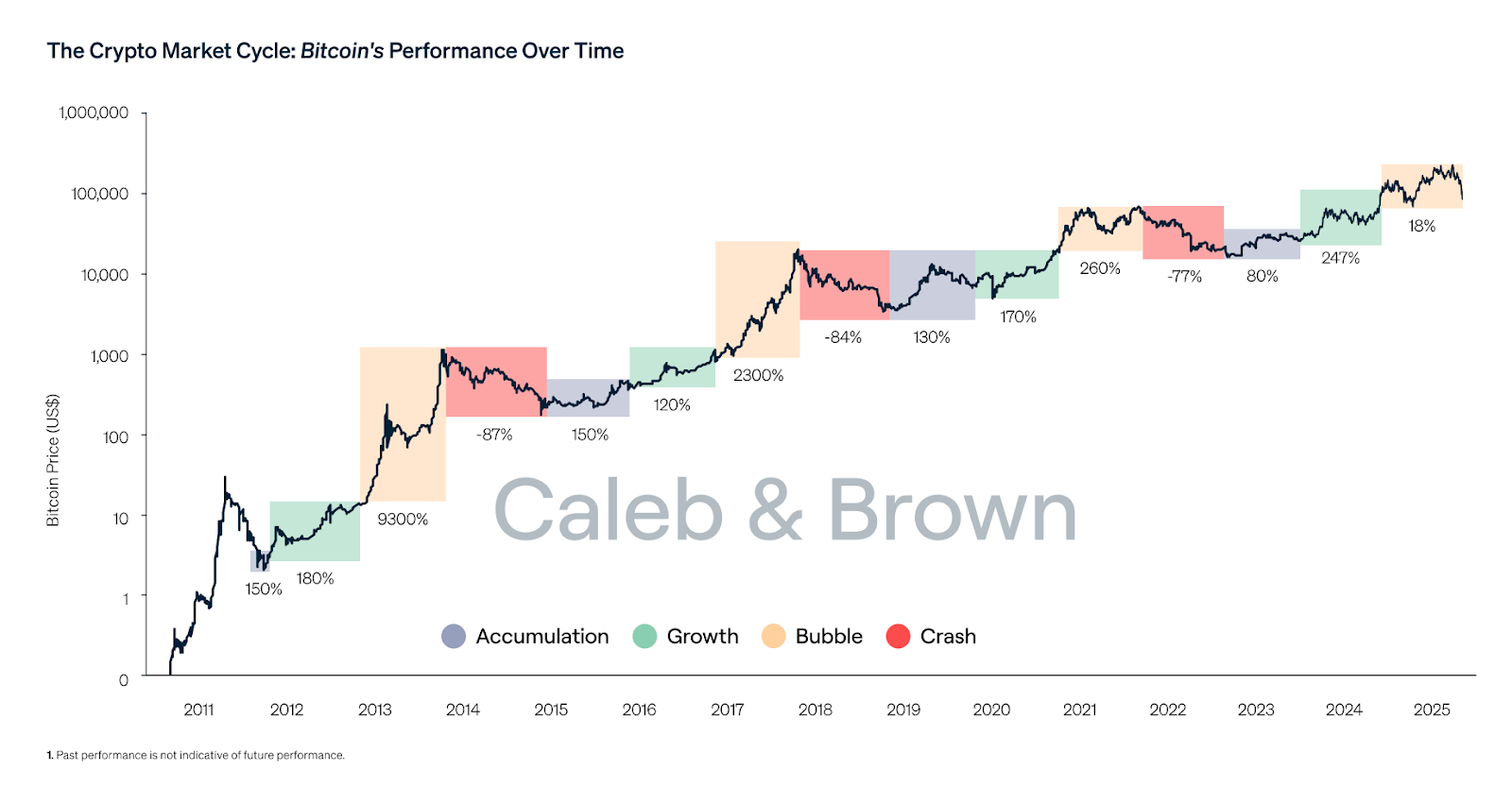
_Source: _Why is Crypto So Volatile? Understanding Market Movements, Caleb & Brown
The most interesting part here, however, is that Gen Z is fully aware of this. 84% of them acknowledged that cryptocurrencies are risky and volatile, yet continue investing, and participation continues to grow every year. Why?
Gen Z understands that digital assets are a great way to have extra, above-average profits, and volatility is perceived as an entry price. For a generation that has already witnessed two of the biggest economic crises in history, average capital growth in traditional investments can feel too slow or insufficient.
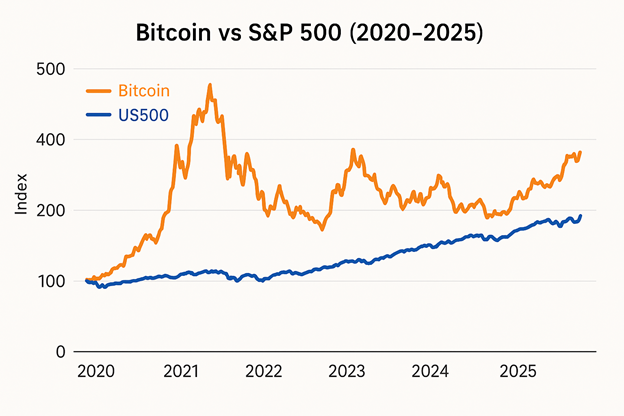
_Source: _Bitcoin Vs. S&P 500: The New Risk Divide
Digital assets also feel native to Gen Z. This is the first generation that has never known a life without the internet, and they are also used to digital wallets and online transactions.
At the same time, their investment behavior is shaped by social media consumption — one in four American Gen Z now gets financial advice from TikTok. Considering that the internet is flooded with so-called “finfluencers,” who help you learnn more about crypto, no surprise that Zoomers tend to invest in it so much.
FOMO and the narrative trap
Beyond risk tolerance, there is another thing that distinguishes Gen Z from previous generations.
It is the fear of missing out (FOMO). This feeling, mostly expressed as the fear of lost profits, is expressed in constant anxiety due to comparing lives with the “perfect” picture on social networks.
FOMO is especially common among Zoomers when it comes to financial matters. In fact, nearly 70% of Gen Z says they feel financial FOMO while scrolling social media. And 50% of Gen Z investors said they have even made an investment driven by this feeling, most often in crypto, in particular, memecoins.
**Related: **__Australia warns of AI, ‘finfluencers’ as Gen Z crypto ownership reaches 23%
Memecoins thrive in this environment. By design, they are made for virality and great coverage in the media and news. The issue is not that they are built on hype, but that they are made to catch the moment and disappear, in most cases. Every memecoin cycle, where it goes up and quickly falls down, strengthens the argument that digital assets are unsafe.
This creates a narrative duality. On one side, crypto is maturing, and institutionals flow in. On the other hand, the industry is still very FOMO-fueled, and this dominates the headlines. And as a result, the loudest crypto stories become more about speculative gains.
Risks that Gen Z underestimate
When Gen Z increasingly invests in crypto, many may be doing so without fully researching the risks. Sometimes they blindly trust TikTok advice without doing their due diligence or reaching out to a financial advisor.
Zoomers mostly feel confident in their decisions. More than 70% of Gen Z saying they are completely sure about their investing behavior. Confidence, however, and especially in crypto, does not mean competence. Younger generations are reportedly more susceptible to the Dunning-Kruger effect. They usually overestimate their knowledge and underestimate risks.
Beyond volatility as a primary risk, Gen Z often neglects the absence of transparency in crypto. Unlike public companies, digital assets have no reporting requirements. A “Wild West” like this, and lack of long-reaching regulation does not bother young crypto enthusiasts. On the contrary, they still trust crypto. They value transparency and direct control a lot. In fact, they should pay more attention to regulation. As it develops, it helps to protect investor rights and turn crypto into a more transparent and trustworthy market.
Investors can also forget that diversification does not simply mean putting 10-20% of your portfolio in crypto. There is the issue of correlation. During periods of systemic stress, crypto has at times moved in line with high-growth equities, weakening its diversification argument. Graphs show that Bitcoin can even correlate with gold, a traditional safe-haven asset.
Or imagine they, for example, choose the wrong coin that is going to fall and put in at least 25%. Without understanding how digital assets work, they risk losing a fourth of their investments.
Still, none of these risks devalues crypto’s role in modern portfolios. On the contrary, crypto might indeed be evolving into a genuine portfolio diversifier.
If that transformation is real, it comes with strings attached.
Opinion by: Alex Tsepaev, chief strategy officer at B2PRIME Group.
This opinion article presents the author’s expert view, and it may not reflect the views of Cointelegraph.com. This content has undergone editorial review to ensure clarity and relevance. Cointelegraph remains committed to transparent reporting and upholding the highest standards of journalism. Readers are encouraged to conduct their own research before taking any actions related to the company.
- #Bitcoin
- #Cryptocurrencies
- #Bitcoin Price
- #Adoption
- #Volatility
- #Digital Asset Holdings
- #Digital Asset
- #Digital Asset Management
- #Trading
Related Articles
Whale Liquidates 1,351 ETH and Opens $50.6M Bitcoin Short on Hyperliquid
Gate News message, April 26 — A whale address beginning with 0x310 opened a 16x leveraged Bitcoin short position on Hyperliquid over the past 30 minutes, with a notional value of $50.6 million across 653 BTC at an average price of $77,470. The liquidation price stands at $81,308, making it the
GateNews19m ago
Quantitative Trader Killa Predicts Bitcoin Bear Market Bottom at $40,740 or $42,680
Gate News message, April 26 — Quantitative trader Killa shared his prediction for Bitcoin's bear market bottom on April 25, estimating the floor at $38,800. Accounting for approximately 5% variance, he projects the bottom could be either $40,740 or $42,680.
Killa previously used a model combining c
GateNews53m ago
Bitcoin Liquidation Cascades: $619M in Short Liquidations if BTC Breaks $80K
Gate News message, April 26 — According to Coinglass data, if Bitcoin breaks $80,000, major centralized exchanges will face cumulative short liquidation intensity of $619 million. Conversely, if BTC falls below $76,000, cumulative long liquidation intensity across major CEXs will reach $645 million.
GateNews3h ago
Bitcoin's 'Winter Is Over,' Says Michael Saylor as Institutional and National Adoption Drive Next Rally
Gate News message, April 26 — Michael Saylor, co-founder of MicroStrategy, declared "winter's over" as Bitcoin traded around $78,000. Analyst Mati Greenspan characterized recent price movements as a correction within a broader bull market rather than a new bear phase, noting that Bitcoin's bottom ha
GateNews5h ago
Analyst: $80K Emerges as Bitcoin's Key Resistance Level, Breakout Could Trigger Increased Volatility
Gate News message, April 26 — On-chain analyst Murphy identified $80,000 as Bitcoin's primary resistance level above the current price, citing a combination of options Gamma exposure, open interest (OI), and implied volatility (IV) data. The level represents a critical checkpoint for May's price
GateNews5h ago
South Africa Crypto Draft Triggers 1M Rand Fine Warning From Valr CEO
Industry leaders and financial experts have issued a sharp rebuke of the South African National Treasury’s Draft Capital Flow Management Regulations 2026, calling the proposal a regressive move that mirrors apartheid-era economic controls.
Key Takeaways:
National Treasury draft replaces 1961
Coinpedia5h ago


