The institution reported that argt, a peso-linked stablecoin, constitutes a security, subject to the regulatory regime for capital markets for these instruments. The stablecoin, issued by Twin Finance and listed by Belo, offered up to 32% APR.
Regulator Classifies Argentine Peso Stablecoin as a Security, Blocks Operations
The Argentine equivalent of the SEC, the CNV, executed the first measure against a stablecoin linked to the national fiat currency, the Argentine peso.
On March 12, the institution issued a resolution ordering the suspension of the listing, offering, and intermediation of argt, stating that the token was classified as a security offered to investors without complying with the rules established for these assets.
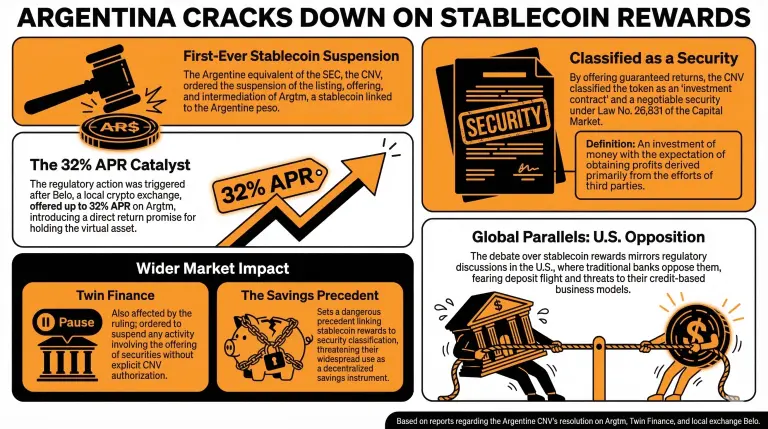
The action comes after Belo, an exchange that listed the stablecoin, offered up to 32% in APR, introducing a return promise linked to holding the virtual asset. As a consequence, the CNV assessed that this would make it “fall under the figure of an investment contract included in the definition of negotiable security provided for in article 2 of Law No. 26,831 of the Capital Market, which results in its classification as a negotiable security subject to the public offering regime.”
The institution clarified that when these assets meet the criteria of an investment contract, “an investment of money in a joint venture with the expectation of obtaining profits derived primarily from the efforts of third parties,” it can be considered a security, and will be subject to the compliance regime described for these assets.
The action also affects Twin Finance, which will have to suspend any activity, including the offering of securities, without the CNV’s authorization.
The development sets a precedent in Argentina, linking the offering of rewards for holding a stablecoin to its classification as a security, closing the potential savings use case for these instruments in the future, with no regulation tackling this issue.
The subject of stablecoin rewards is also being discussed in the U.S., as banks have opposed it, alleging that it could fuel deposit flight from the financial system and affect their credit intermediation-based business model.
FAQ
- What recent action did Argentina’s CNV take regarding a stablecoin?
The CNV suspended the listing and intermediation of argt, classifying it as a security being offered without regulatory compliance.
- Why was argt classified as a security?
The token was categorized as a security because it was linked to an investment contract promising up to 32% APR for holding the virtual asset.
- What implications does this resolution have for Twin Finance?
Twin Finance must halt all activities involving the stablecoin, including offering securities, without prior authorization from the CNV.
- What broader impact does this decision have on stablecoin offerings in Argentina?
This action sets a precedent by linking rewards for holding stablecoins to their classification as securities, potentially limiting their use for savings in the country.
Isenção de responsabilidade: As informações contidas nesta página podem ser provenientes de terceiros e não representam os pontos de vista ou opiniões da Gate. O conteúdo apresentado nesta página é apenas para referência e não constitui qualquer aconselhamento financeiro, de investimento ou jurídico. A Gate não garante a exatidão ou o carácter exaustivo das informações e não poderá ser responsabilizada por quaisquer perdas resultantes da utilização destas informações. Os investimentos em ativos virtuais implicam riscos elevados e estão sujeitos a uma volatilidade de preços significativa. Pode perder todo o seu capital investido. Compreenda plenamente os riscos relevantes e tome decisões prudentes com base na sua própria situação financeira e tolerância ao risco. Para mais informações, consulte a
Isenção de responsabilidade.
Related Articles
Plataforma de redes sociais X apresenta plano de correção à Comissão Europeia sobre questões de certificação azul
A plataforma de media social X de Musk apresentou um plano de conformidade sob pressão da Comissão Europeia, após ter sido multada em 120 milhões de euros por violações incluindo "verificação com distintivo azul". A União Europeia apontou problemas na verificação paga do X, falta de transparência em publicidade e acesso a dados não conforme.
GateNews2h atrás
Confronto Banco–Cripto Atrasa Progresso da Lei de Clareza do Senado
Disputa sobre programas de recompensas em stablecoins entre bancos e empresas cripto desacelerou o progresso da Lei de Clareza do Senado.
Os bancos alertam que recompensas poderiam desencadear fuga de depósitos, enquanto defensores de cripto dizem que evidências de grandes mudanças são limitadas.
Legisladores incluindo os Senadores Alsobrooks e Tillis estão
CryptoFrontNews3h atrás
Bitcoin Policy Institute apela à modificação das regras fiscais americanas, sendo que as regras atuais tratam todos os pagamentos em BTC como ganhos de capital
Gate News refere que, a 13 de março, o Bitcoin Policy Institute (Instituto de Política de Bitcoin) apelou à modificação das atuais regras fiscais americanas. De acordo com as regras atuais, todos os pagamentos efetuados com BTC são considerados transações de ganho de capital, sujeitas ao pagamento de impostos correspondentes. A instituição considera que esta regulação limita a aplicação prática do bitcoin como meio de pagamento.
GateNews5h atrás
Primeira lista de licenças de "stablecoin" de Hong Kong está prestes a ser revelada! Relatos indicam que HSBC, Standard Chartered e OSL são os beneficiários
Hong Kong's first batch of "stablecoin issuer licenses" list will be announced next week, with three main applicants being HSBC, Standard Chartered Bank, and virtual asset platform OSL. This licensing may favor banks due to their capital strength and regulatory advantages, while OSL has rich practical experience. Although rumors suggest the main list is finalized, the actual situation could still change.
区块客5h atrás
A trégua na "guerra civil" da regulamentação de criptomoedas nos EUA: a disputa de dez anos pelo poder entre a SEC e a CFTC chega a um ponto de viragem
A indústria de criptografia dos EUA tem enfrentado confusão prolongada no sistema regulatório, principalmente refletida na determinação da natureza dos ativos criptográficos e na divisão das autoridades regulatórias. As divergências entre a SEC e a CFTC resultaram em múltiplos desafios regulatórios para as empresas. Recentemente, ambas as partes assinaram um memorando e começaram a trabalhar em conjunto para resolver conflitos regulatórios, promovendo o estabelecimento de um marco regulatório adaptável, com o objetivo de formar um sistema completo de regulação de ativos digitais. Isto marca o gradual esclarecimento dos EUA na formulação de regras na era das finanças digitais.
PANews6h atrás


