In recent days, the Bitcoin market has gone through a phase of uncertainty that has left many traders and investors holding their breath. October, usually considered a historically strong month for BTC, has this time disappointed expectations. After a brief bullish push, the price lost momentum, scaring those who feared they were at the end of the bullish cycle that started months ago. Yet, looking closely at the on-chain data, the picture seems less dramatic than it appears at first glance. Some analysts suggest that we are not at the end of a bull market, but merely in a moment of reorganization, a phase of market restructuring after months of growth.
BTC is not in the “final cyclical phase”: the opinion of XWIN Research Japan
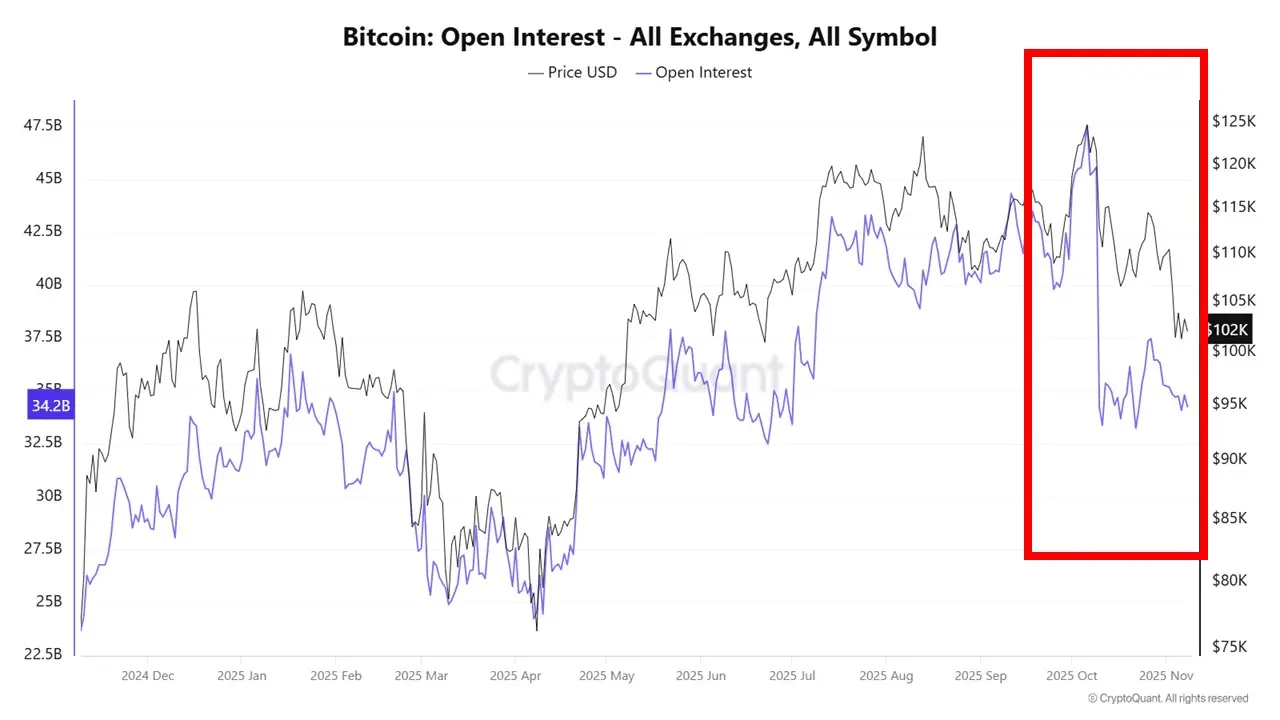
According to the analysis by XWIN Research Japan, published on CryptoQuant, the current condition of Bitcoin does not correspond to the typical signals of a market top. The indicators do not show widespread euphoria, but rather a structural consolidation. The open interest, which is the total of open positions on BTC futures, has sharply declined since the end of October. This drop is significant because it suggests that many leveraged traders are closing their positions. In other words, the market is “deflating” speculation, reducing the pressure from overly risky trades.
(Source: CryptoQuant)
In the final stages of a bull cycle, the opposite usually happens: leverage increases as everyone tries to ride the last pump. This time, however, the dynamic is reversed — a sign that the market is not in “top mania” mode, but in a technical pause. Another interesting indicator concerns the behavior of institutional investors, particularly those in the United States. The so-called “Coinbase Premium Index,” which measures the price difference of Bitcoin between Coinbase and other global exchanges, has recently turned negative. This means that demand for BTC in the United States is weaker compared to the rest of the world. However, XWIN interprets this not as a signal of flight, but as part of the ongoing restructuring: institutions are simply repositioning themselves in anticipation of a clearer macro context, especially in light of the upcoming monetary policy decisions.
Positive signals despite the complex phase
Despite appearances, there are positive signals that suggest not to panic. Bitcoin reserves on exchanges are at their lowest in several years. When BTC disappears from exchanges, it usually means that long-term holders are moving it to private wallets, intending to hold it rather than sell it. This behavior, often associated with HODLers, tends to create a solid base under the price. Less available supply means less selling pressure, and consequently greater stability in the medium term.
In parallel, liquidity in stablecoins — that is, the capital in USDT, USDC, and similar parked in wallets and exchanges — is starting to grow again. It’s a subtle but crucial signal: it indicates that there are funds ready to re-enter the crypto market. Often, an increase in liquidity in stablecoins anticipates new buying flows, because it represents “gunpowder” waiting to be converted into digital assets. However, XWIN warns that in the short term, explosive movements should not be expected: Bitcoin may remain in a consolidation phase for weeks or months, fluctuating within a rather narrow range.
Implications for those who invest in or follow the crypto market
In this context, many investors are wondering how to behave. Those trading with leverage should probably remain cautious: volatility may remain low, but sudden price spikes can hit overly exposed positions. In contrast, long-term investors may view this phase as an opportunity for gradual accumulation, taking advantage of calm periods to build their positions. This is not an invitation to buy blindly, but to recognize that the fundamentals of Bitcoin have not changed: the supply remains limited, global demand is slowly growing, and the next halving is approaching.
Disclaimer: The information on this page may come from third parties and does not represent the views or opinions of Gate. The content displayed on this page is for reference only and does not constitute any financial, investment, or legal advice. Gate does not guarantee the accuracy or completeness of the information and shall not be liable for any losses arising from the use of this information. Virtual asset investments carry high risks and are subject to significant price volatility. You may lose all of your invested principal. Please fully understand the relevant risks and make prudent decisions based on your own financial situation and risk tolerance. For details, please refer to
Disclaimer.
Related Articles
Tether Enters Bitcoin Lightning Network, USDT Seeks to Reshape Crypto Payment Landscape and On-Chain Transfer Efficiency
Tether is accelerating the introduction of USDT into the Bitcoin Lightning Network to enhance transfer efficiency and expand application scenarios. This move combines stablecoins with Bitcoin, promoting efficient payments and cross-chain application development, and is expected to improve the usability of cryptocurrency payment systems, though it faces market competition and technical challenges.
GateNews2m ago
Bitcoin rebounds to $70,800, oil prices decline supports market but upward momentum diverges
On March 20, Bitcoin rebounded to $70,800, with gains exceeding 1%, after multiple countries pledged to ensure freedom of navigation through the Strait of Hormuz. Energy market shifts drove oil prices lower, but uncertainty from Middle East conflicts created bearish signals in traditional markets affecting crypto assets. Bitcoin's near-term trajectory remains dominated by macroeconomic factors, with $70,000 as a key level to watch.
GateNews3m ago
The Federal Reserve's hawkish stance suppresses risk appetite, putting Bitcoin's price pressure below the $70,000 level.
On March 20, the Federal Reserve maintained interest rates unchanged, and Bitcoin's price quickly retreated to around $70,000, with a decline approaching 5%. Market risk appetite cooled, with Ethereum, Dogecoin, and others also coming under pressure, demonstrating the impact of macroeconomic factors on the crypto market. Analysts pointed out that Bitcoin trading will depend on selective capital flows, and elevated interest rates combined with geopolitical risks may cause it to maintain a volatile and weak pattern in the short term.
GateNews8m ago
SEC Token Classification Framework Takes Effect, Bitcoin and Ethereum Face Major Regulatory Status Shift
The U.S. Securities and Exchange Commission (SEC) has released a "Token Classification Framework" that provides clear guidance for cryptocurrency asset regulation and reduces compliance uncertainty. This guidance categorizes crypto assets and helps promote industry stability, but formal legislative support is still needed to ensure long-term predictability.
GateNews9m ago
UK Crypto Tax New Rules Take Effect, User Data Sharing Raises Security Risk Concerns
The United Kingdom implemented new CARF-based regulations on March 20th, requiring crypto service providers to submit detailed user information to tax authorities, with automatic data exchange with over 70 countries planned for 2027. This mechanism aims to curb tax evasion but has raised privacy and security concerns, particularly regarding the increase in violent incidents such as "wrench attacks." Analysts believe that balancing regulation with user safety will be a key challenge going forward.
GateNews18m ago


