Author: Jjay Source: Wintermute Translator: Shan Oppa, Golden Finance
Market Update - November 17, 2025 The recent cryptocurrency sell-off was driven by a repricing of interest rate cut expectations, rather than a structural breakdown. Current market positions are more refreshed, and the global easing cycle continues. Bitcoin (BTC) needs to reclaim its previous fluctuation range for overall market sentiment to improve.
Macro Market Update
Last week, the core theme of the market was the sudden repricing of the expectation for a rate cut in December. In just one week, the probability of a rate cut in December dropped from about 70% to 42%, while the absence of other macro data further amplified this volatility. Powell retracted his previously almost certain statement about a December rate cut, forcing investors to reassess the policy tendencies of the members of the Federal Open Market Committee (FOMC), which revealed that there was far from a consensus on a rate cut. The market reacted immediately: U.S. risk assets weakened, and the most sensitive risk assets to sentiment — cryptocurrencies — suffered the most severe impact.
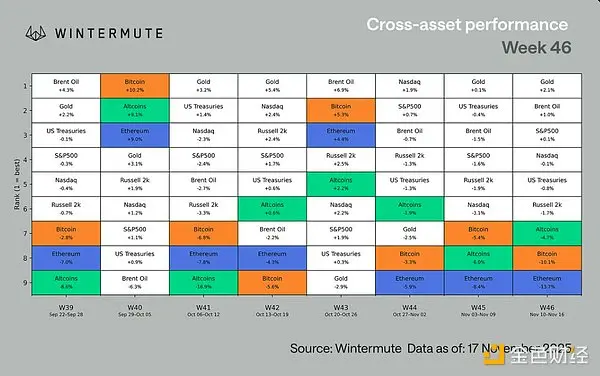
In terms of asset classes, digital assets are still at the bottom of the performance rankings. This weakness is not a new phenomenon: since early summer, cryptocurrencies have lagged behind the stock market, partly due to their persistent negative skew relative to the stock market. Notably, the performance of Bitcoin and Ethereum (ETH) is even worse than that of altcoins overall, a situation that is rare during a downturn. There are two main reasons for this:
- Altcoins have been weakening for a period of time.
- Privacy coins, fee switching and other niche tracks still show localized strength.
On the industry level, performance has weakened across the board. The GMCI-30 index (@gmci_) dropped 12%, with most industries seeing declines between 14% and 18%. Artificial Intelligence (AI), Decentralized Physical Infrastructure Networks (DePIN), gaming, and meme coins led the drop. Even the typically more resilient Layer 1 networks (L1s), Layer 2 networks (L2s), and Decentralized Finance (DeFi) showed widespread weakness. This decline exhibits characteristics of a broad market downturn, reflecting a general risk-averse sentiment rather than sector rotation.
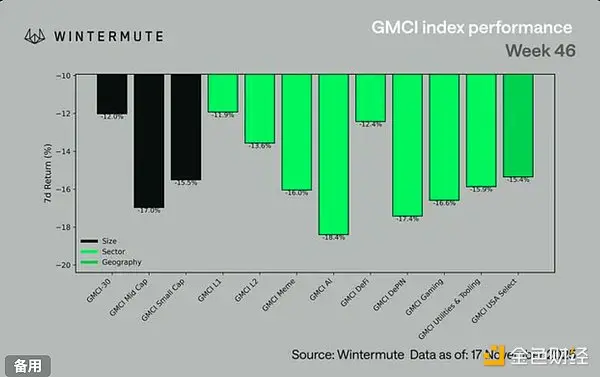
(Note: The statistical period in the above chart is from Monday to Monday, hence there is a discrepancy with the data in the first chart.)
Bitcoin has once again fallen below the $100,000 mark, marking the first time since May. Before last week, Bitcoin had managed to hold the $100,000 mark twice (on November 4 and 7) and rebounded to $110,000 at the beginning of last week. However, this rebound was followed by a significant decline (mainly during the U.S. trading hours), and the hourly chart shows a clear pattern: selling pressure emerged after the U.S. market opened, and ultimately, after two tests of support, the $100,000 mark was lost.
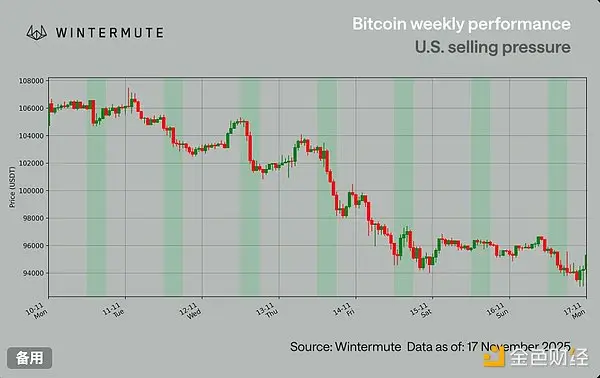
Some of the selling pressure comes from whale investors reducing their holdings. The sell-off from the fourth quarter to the first quarter of the following year usually has seasonal characteristics, but this year this trend has arrived early, partly because many traders believe that according to the four-year cycle rule, the market may be relatively weak next year. This expectation has created a self-fulfilling cycle — participants reduce their risk exposure in advance, further amplifying the decline. The key point is that this volatility does not involve a real fundamental breakdown: the selling pressure is dominated by the U.S. market and driven by macro factors.

The repricing of rate cut expectations is a more rational driving factor. After Powell retracted his statements about a rate cut in December, U.S. traders began to analyze the views of the members of the Federal Open Market Committee (FOMC) in depth. The U.S. trading sector was the first to lower the probability of a rate cut in December from around 70% to the lower end of the 60% range, after which global markets followed suit in adjustment. This also explains why the selling pressure was heaviest during the U.S. trading period from November 10 to December 12, even though the probability of a rate cut in the open market was still in the mid-range of 60% at that time.
Although the expectation of interest rate cuts dominates short-term sentiment, the overall macro environment has not deteriorated. The global easing cycle is still ongoing:
- Japan is preparing a $110 billion stimulus plan
- China continues to implement monetary easing policies
- The US Quantitative Tightening (QT) plan will end next month.
- The proposed $2000 stimulus plan and other financial channels are still progressing.
This market adjustment is more about the rhythm rather than the direction - the speed of liquidity release and the time it takes to transmit to speculative risk assets. Currently, cryptocurrencies are almost entirely following macro trends, and in the absence of new data anchoring interest rate cut expectations, the market remains largely reactive and has yet to form a constructive trend.
Core Insights
The macro environment remains supportive, and the market feels clearer after the position reset, but a stabilization in sentiment requires a strong performance from mainstream cryptocurrencies.
This sell-off seems more like a macro-driven position clearing rather than a structural breakdown. The current market positions have been cleaned up, and the logic behind the selling pressure dominated by the U.S. has been fully understood. The behavior of whale investors and cyclical factors such as year-end capital flows largely explain this volatility.
The overall background remains constructive: global easing continues, the U.S. quantitative tightening is set to end next month, stimulus channels remain effective, and liquidity is expected to improve in the first quarter of next year. What is currently lacking is the confirmation of a rebound in mainstream cryptocurrencies. Before Bitcoin approaches the upper bound of the consolidation range again, market breadth may remain narrow, and industry narratives will struggle to persist. The current macro landscape does not align with the characteristics of a long-term bear market. As the market is driven by macro factors, the next catalyst is more likely to come from policy adjustments and changes in interest rate cut expectations, rather than from the native capital flows of cryptocurrencies. Once mainstream cryptocurrencies regain upward momentum, the market is expected to see a broader rebound.
Disclaimer: The information on this page may come from third parties and does not represent the views or opinions of Gate. The content displayed on this page is for reference only and does not constitute any financial, investment, or legal advice. Gate does not guarantee the accuracy or completeness of the information and shall not be liable for any losses arising from the use of this information. Virtual asset investments carry high risks and are subject to significant price volatility. You may lose all of your invested principal. Please fully understand the relevant risks and make prudent decisions based on your own financial situation and risk tolerance. For details, please refer to
Disclaimer.
Related Articles
Institutional Capital Inflows Drive Bitcoin ETF Six Consecutive Days of Net Inflows, BTC Price Rises Over 12% During Period
On March 17, US Bitcoin ETFs achieved net inflows for six consecutive days, with total capital reaching $962.8 million, and Bitcoin price rose more than 12%. Analysts believe that geopolitical tensions and Bitcoin's safe-haven attributes have driven institutional demand, with the market maintaining attention on its future trajectory.
GateNews17m ago
Robert Kiyosaki Warns of Global Market Crash, Bitcoin Could Soar to $750,000
"Rich Dad Poor Dad" author Robert Kiyosaki has issued another warning that global markets could crash, predicting that Bitcoin and hard assets will surge significantly. He forecasts Bitcoin could reach $750,000, emphasizing the importance of holding cash and diversifying investments to navigate market volatility.
GateNews18m ago
Macro Analysts Warn of Private Credit Crisis, Bitcoin May Become Top Safe-Haven Choice
As artificial intelligence intensifies its impact on software revenue, the private credit market faces mounting pressure with default rates climbing to 5.8%. Analysts warn that additional monetary expansion may be necessary, while Bitcoin has emerged as a hedging tool for investors, with its appeal growing amid uncertainty. The market needs to monitor developments in private credit dynamics and the impact of policy adjustments on Bitcoin's price.
GateNews20m ago
Bitcoin Surpasses $75,000: Short Liquidations Exceed $330 Million, Continuous ETF Inflows Drive Market Rally
Bitcoin's price broke through $75,000 on March 17, hitting a six-week high, accompanied by large-scale short position liquidations. Crypto market liquidations in the past 24 hours approached $498 million, with mainstream altcoins also performing strongly. Spot Bitcoin ETFs have attracted significant institutional capital inflows, boosting market confidence. Technical analysis shows Bitcoin has further upside potential, with resistance at $79,000 and support at $72,000.
GateNews27m ago
France Cryptocurrency Kidnapping Case Escalates: Teenager Involved in Bomb Threats, Helicopter Deployment Shocks Paris Suburbs
A violent incident involving a cryptocurrency holder occurred in the Île-de-France region of France, with police deploying massive forces to pursue underage suspects. The case involves two attacks—one cryptocurrency holder was robbed at knifepoint during a home invasion, and another incident involved the kidnapping of a family and theft of valuables. In recent years, such crimes have been rising in France, particularly targeting high-net-worth cryptocurrency asset holders.
GateNews28m ago


