The recent dramatic fluctuation in Bitcoin prices has left short-term traders feeling uneasy, prompting investors to question whether the market is undergoing a temporary adjustment or is about to enter a long-term fall. However, for long-term retirement investors, the price drop can provide strategic get on board opportunities. Jonathan Rose, CEO of BlockTrust IRA, stated that the recent pullback in crypto assets has led to the busiest week in history for BlockTrust IRA.
Market slump ignites a surge in retirement account openings
Jonathan Rose, CEO of BlockTrust IRA, stated that periods of market downturn often bring the most attractive investment opportunities. He pointed out that the recent pullback in crypto asset prices has led to the busiest week in the history of BlockTrust IRA. BlockTrust IRA is a platform based in the United States that allows retail investors to hold crypto assets in tax-advantaged retirement accounts.
He said, “We see that investors are pouring into BlockTrust IRA accounts to invest in crypto assets, which indicates that Bitcoin will continue to exist, and now is a good time to get on board.” This phenomenon seems counterintuitive, as most retail investors tend to wait and see or exit when prices fall, rather than buy in. However, the retirement investor group shows a distinct behavior pattern.
Alto is a platform that allows users to add alternative assets to self-directed retirement accounts, and its data corroborates this trend. The company reported that its 29,000 self-directed IRA users conducted over 240,000 cryptocurrency transactions last year. Alto also stated that proprietary data on its platform reflects the growing confidence in cryptocurrency investments as part of self-directed IRAs.
The logic behind this trend lies in the time horizon of retirement investors. Unlike traders seeking short-term profits, retirement investors typically plan to hold assets for decades. In this time frame, short-term price fluctuations become less important, while the opportunity to accumulate more assets becomes more valuable. Ross added that Bitcoin's recent fall has opened the door for investors who previously felt they “missed the opportunity.” “For retirement investors planning to hold Bitcoin for 10, 20, or even 30 years, a price drop simply means a lower get on board point,” he said.
Ryan Flynn, the head of Swan Advisor (a wealth management company focused on Bitcoin) under Swan Bitcoin, told Cryptonews that purchasing activity across all account types, including IRA accounts, tends to increase during market pullbacks. Flynn stated, “The fall in Bitcoin prices is normal, as Bitcoin continues its monetization process, which provides buying opportunities for those who understand its fundamentals.”
The fundamentals of Bitcoin do not change with the price
Melanion Capital CEO Jad Comair added that the pullback of Bitcoin is different from traditional assets. He explained that traditional stock investments usually fall when fundamentals deteriorate. However, Comair pointed out that the way Bitcoin investments operate is different. He stated, “The fundamentals of Bitcoin do not change with price pullbacks. The supply plan remains unchanged, the halving mechanism continues, and the global adoption rate is also steadily expanding.”
This perspective touches on the uniqueness of Bitcoin as an investment target. The stock value of traditional companies depends on their profitability, market share, and management decisions, which can change over time. When stock prices fall, it may reflect a deterioration in the company's fundamentals, giving investors reason for concern. In contrast, Bitcoin's value proposition is built on its scarcity (a cap of 21 million coins), decentralized nature, and global acceptance, factors that do not change due to price fluctuations.
The Bitcoin halving mechanism ensures that the supply of new coins is halved every four years. This deflationary characteristic is at the core of its long-term value support. The continued expansion of its global adoption means that more and more individuals and institutions view Bitcoin as a legitimate asset class. These fundamentals have not changed at all during the process of the price falling from $125,000 to $90,000, which is why long-term investors see the drop as a buying opportunity rather than a risk signal.
Tax incentives strengthen the mathematical logic of buying on the dip
The lower price itself creates highly attractive purchasing conditions, and Bitcoin Individual Retirement Accounts (Bitcoin IRA) offer additional advantages. The most obvious benefit of Bitcoin's price fall is that more Bitcoin can be purchased with the same dollar amount. In tax-advantaged retirement accounts, this effect accumulates over decades.
The returns from a Traditional Bitcoin IRA can be tax-deferred; while the returns from a Roth Bitcoin IRA can grow tax-free. Accumulating Bitcoin at a discounted price within these accounts can maximize long-term appreciation without triggering any taxable events in the process.
“Specifically regarding Roth IRA accounts, this allows for greater tax-free gains from future price increases of Bitcoin. The pullback strategy enables retirement investors to maximize the annual contribution limit, thereby increasing the proportion of Bitcoin investments in the account,” Flynn explained. He also added that when Bitcoin's price fell from $125,000 to $90,000, the same $7,000 annual investment could purchase nearly 40% more Bitcoin.
Mathematical Advantages of Tax Incentives
Traditional IRA: Tax-deductible contributions, tax-deferred growth of earnings, and taxes are paid upon withdrawal in retirement (typically at a lower tax rate after retirement).
Roth IRA: Contributions are made with after-tax money, but all earnings are completely tax-free, making it especially suitable for investors expecting significant long-term appreciation in Bitcoin.
Flynn stated, “These advantages mainly benefit those investors who plan to retire in the next 5 to 10 years or even longer.” However, Flynn pointed out that these negative factors have a particularly significant impact on investors who are already retired or about to retire. This is because these individuals do not have enough time to recover to their previous peak earnings before they begin receiving dividends.
Flynn stated, “There is a behavioral risk in that investors who do not understand what Bitcoin represents are at a disadvantage and may be more prone to panic selling as they approach local bottoms.” Jonathan Bander, a certified public accountant at the New York accounting firm ExperityCPA, further told Cryptonews that while the drop in Bitcoin prices can be used for tax loss deductions to offset gains, the downsides include the inability to deduct personal income within IRA accounts and the ongoing risk of Fluctuation.
Who should consider a Bitcoin IRA?
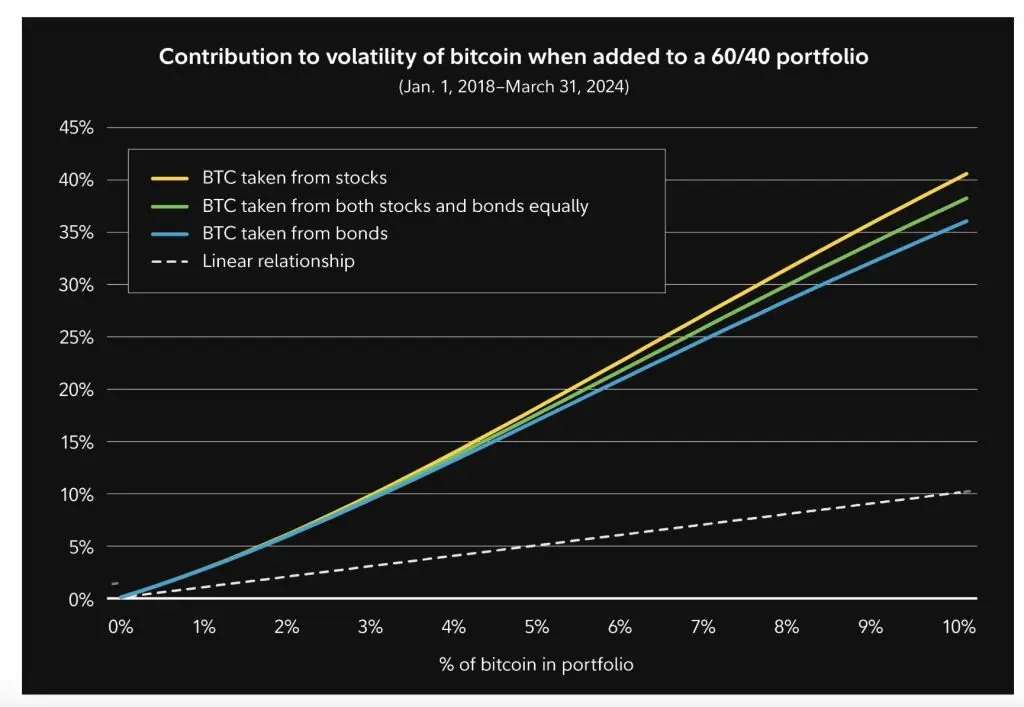
(Source: Fidelity Research)
Although industry experts generally believe that the fall of Bitcoin may benefit long-term retirement investors, the specific situation varies by investor. The volatility of Crypto Assets is extremely high and may be more susceptible to manipulation than registered securities. Therefore, Comair believes that young investors may benefit the most. He said, “They have the longest time to allow the structural appreciation of Bitcoin to continue, and they can treat the volatility like the historical falls of other large companies.”
Comair added that investors with stable cash flows and less liquidity pressure may also find Bitcoin IRAs attractive. “These individuals can continue to invest during price pullbacks without being forced to sell.” Investors concerned about the long-term depreciation of fiat currency may also be suited for Bitcoin, as Comair commented that Bitcoin's fixed supply and institutional adoption make it a strategic hedge tool for retirement portfolios, which often focus on assets related to central bank policies.
However, for more cautious investors or those approaching retirement who cannot withstand significant fluctuations, it may be worth reconsidering whether to open a Bitcoin IRA. Research by Fidelity Investments has found that during certain specific periods in the past, incorporating Bitcoin into a portfolio could indeed enhance returns, but even a small allocation of Bitcoin would significantly increase the portfolio's volatility.
As the overall cryptocurrency market matures, the demand for Bitcoin Individual Retirement Accounts (Bitcoin IRA) seems poised for accelerated growth. Rose stated that BlockTrust has already seen an increasing number of international investors showing strong interest in investing through U.S. Bitcoin Individual Retirement Accounts. Kemmer believes that this trend is just beginning. He predicts that by 2026, Bitcoin will occupy a “more central position” in retirement strategies. “The penetration rate of exchange-traded funds will further increase, corporate ownership will become more prevalent, and the supply mechanism post-halving will also become tighter. This period will be remembered by retirement investors as a time when buying structural appreciation assets on dips became the norm, rather than a phase of contrarian trading.”


