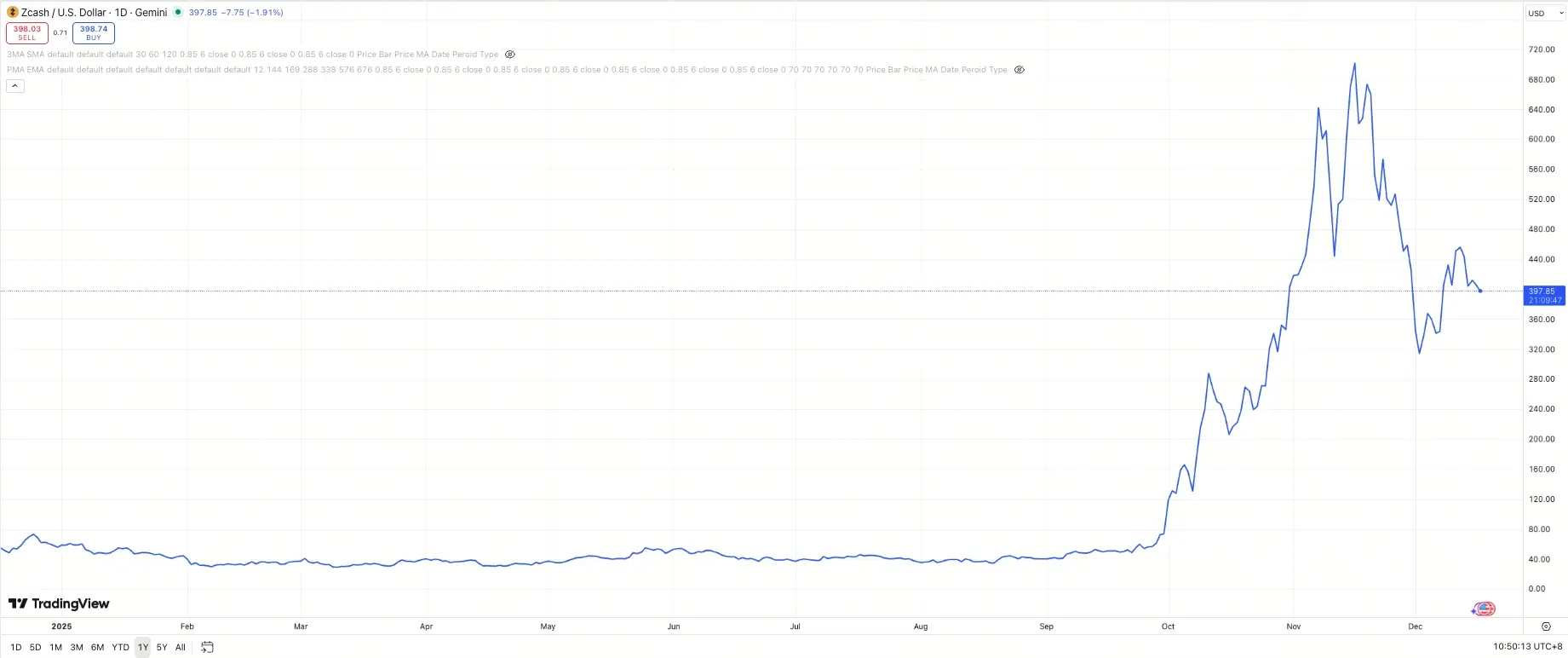
Zcash has been soaring since October 2025, with its market capitalization once surpassing $10 billion. Why did this privacy coin, dormant for 9 years, suddenly become so popular? The answer lies in three key shifts: maturity of zero-knowledge proof technology, the rise of optional privacy aligning with compliance trends, and collective endorsements from Silicon Valley investors. From technological fundamentals to market positioning, Zcash is rewriting the rules of privacy coins.
The Three Main Drivers Behind the 2025 Surge
(Source: Trading View)
Zcash’s breakout was no accident. Starting in Q4 2025, the price of ZEC skyrocketed over 300% from its lows, and its market cap broke through the $10 billion mark from less than $3 billion. The core drivers of this rally resonated across three levels.
First is a shift in social psychology. As AI technology advances and data surveillance becomes more embedded in daily life, the public increasingly recognizes the value of privacy. An analyst pointed out: “In an era surrounded by algorithms, data, and monitoring, privacy rights have shifted from a marginal issue to a public focus. Zcash’s rapid rise reflects this societal change.” The proportion of shielded pools in total supply increased from 15% in 2024 to 22% in November 2025, with about 4.69 million ZEC locked in privacy addresses, indicating genuine demand is rising.
Second is technological upgrades that deliver performance breakthroughs. The Hydra project launched in October 2022 significantly improved throughput and privacy features for shielded transactions. The official wallet Zashi, released in 2025, is seen as a turning point for user experience. Previously, using Zcash required manual switching between transparent addresses (t addresses) and shielded addresses (z addresses), which was technically complex. Zashi simplified the process, making privacy transactions as easy as using a regular wallet, directly fueling a surge in on-chain activity.
Third is the concentrated attention from capital and public opinion. Prominent figures in crypto and Silicon Valley such as Arthur Hayes, Naval Ravikant, and Mert Mumtaz publicly expressed support for Zcash, viewing it as a technological fortress for privacy rights. These endorsements attracted speculative capital seeking “value rebound” targets, turning the long-dormant privacy coin sector into a natural emotional outlet.
How Zero-Knowledge Proofs Are Disrupting the Privacy Market
Zcash’s core competitiveness stems from zk-SNARKs (Zero-Knowledge Succinct Non-Interactive Argument of Knowledge). This technology was first proposed by cryptographers Shafi Goldwasser, Silvio Micali, and Charles Rackoff in 1985, earning them the Gödel Prize. In 2013, Nir Bitansky, Ran Canetti, Alessandro Chiesa, Eran Tromer, and others published the seminal paper “SNARKs for C,” laying the theoretical foundation for zk-SNARKs.
Three Key Technical Features of zk-SNARKs
Succinct: The proof size and verification time are very small, suitable for practical applications. A single transaction proof is usually less than 200 bytes.
Non-Interactive: The prover and verifier do not need multiple rounds of communication; a single proof suffices for verification, greatly reducing network load.
Argument of Knowledge: Ensures the prover truly knows the secret they claim, preventing false proof attacks.
In 2016, the Zcash team first applied this theory to cryptocurrency, enabling transaction validation without revealing amounts, sender, or receiver. This technology allows shielded transactions on a public blockchain to be completely private and untraceable, while still preventing token creation out of thin air or double-spending.
Compared to Bitcoin, Zcash inherits Bitcoin’s robustness, scarcity (max supply of 21 million), and PoW consensus mechanism, with an added privacy layer. Compared to Monero, Zcash consumes more resources (each shielded transaction requires zk-SNARKs proof computation), but offers “optional privacy”—a key strategic difference from Monero.
Optional Privacy as a Key Advantage for Institutional Adoption
Zcash’s “selective transparency” opens a new path for privacy technology development. Users can generate “viewing keys” to authorize specific institutions or regulators to view details of shielded transactions. This design, in a 2025 environment emphasizing compliance, is a major positive.
Monero employs full anonymity modes (using ring signatures and other techniques), which led to delistings or restrictions by major exchanges like Coinbase and Binance after 2017. In contrast, Zcash’s dual address system—transparent addresses (t addresses) and shielded addresses (z addresses)—provides flexibility for institutions. Companies or financial entities can conduct transactions using shielded addresses and keep off-chain records, providing evidence when required by regulators.
This compliance-friendly feature makes Zcash easier for exchanges to accept. When users buy or sell Zcash on exchanges, they must undergo KYC, enabling regulators to trace fund sources and destinations. This sharply contrasts with Monero wallets, which do not require KYC. For institutional investors, the ability to maintain privacy while meeting regulatory requirements is a decisive factor in choosing Zcash over other privacy coins.
Additionally, Zcash’s integration of NEAR Intents enables cross-chain transactions without relying on exchanges. Protocols like Splyce and Chintai allow retail investors to directly access tokenized securities on the network, further expanding Zcash’s application scenarios in DeFi and traditional finance.
Token Economics and Ecosystem Development
Zcash’s token ZEC is based on Bitcoin’s codebase, with a maximum supply of 21 million. When the mainnet launched in October 2016, the block reward was 12.5 ZEC, halving approximately every four years. The second halving occurred in November 2024, reducing the block reward from 3.125 ZEC to 1.5625 ZEC. The current circulating supply is about 16.38 million (78%), with a market cap around $7.8 billion.
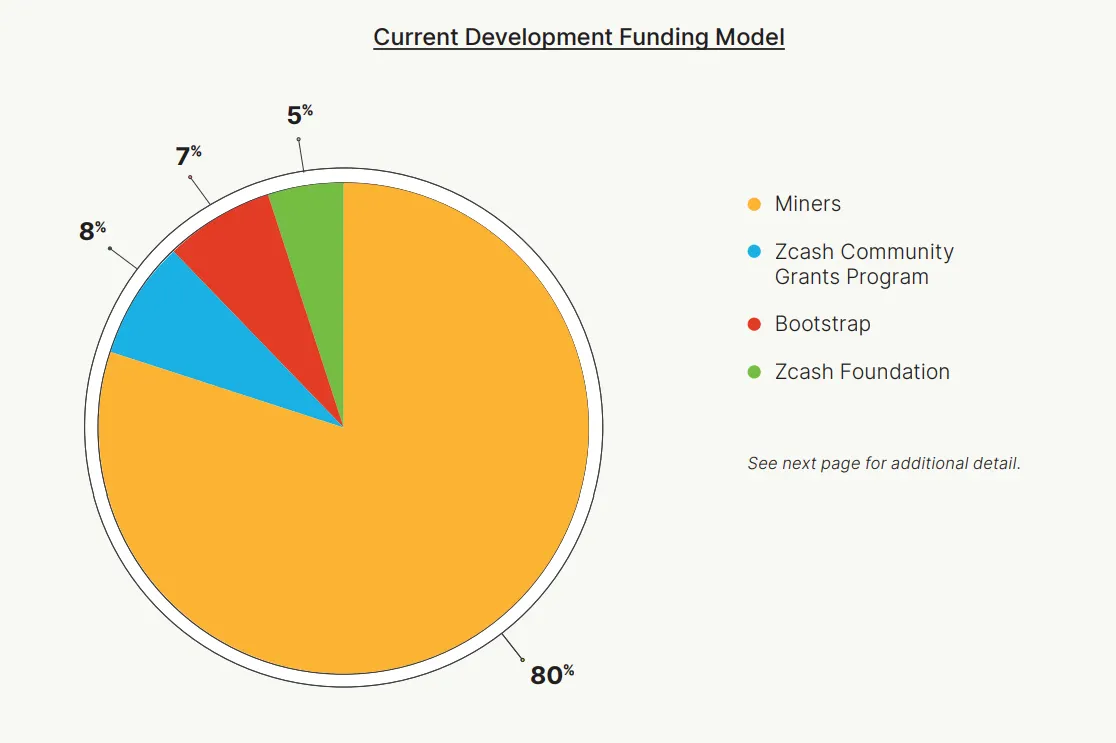
Early on, Zcash employed a “Founders’ Reward,” allocating 20% of block rewards to the development team and investors, which sparked debates over decentralization. After 2020, the ZIP 1016 proposal replaced the old model, distributing the 20% reward as follows: Electric Coin Company (7%), Zcash Foundation (5%), and Zcash Community Fund (8%), increasing transparency and democratic governance.
Zcash was founded by Zooko Wilcox, with a team including zk-proof expert Eran Tromer and former Columbia University professor Aviel D. Rubin, among other cryptography authorities. Electric Coin Company (ECC) handles protocol development, while the Zcash Foundation promotes community engagement. Notably, according to ECC’s transparency reports, in Q4 2024, ECC’s monthly expenses averaged about $375,000, while the monthly token income was only about $293,000, creating a funding gap. However, after the price surge in October 2025, ECC’s ZEC holdings increased significantly in value, alleviating financial pressures.
Risks and Future Challenges
Despite the optimistic outlook, Zcash faces challenges. The degree of node decentralization is a major concern, with about 1,743 nodes (56% in the US), compared to Bitcoin’s roughly 17,000 nodes, indicating high centralization. This is mainly because verifying shielded transactions requires higher hardware resources, raising the barrier to running nodes. Developers are pushing the “Tachyon Project” (testnet expected in Q1 2026) to improve node efficiency, indirectly lowering the entry barrier and enhancing decentralization.
Additionally, not all cold wallets support Zcash’s z-addresses. Most exchange wallets (like Binance, Coinbase) do not support shielded addresses, limiting privacy feature adoption. Improving user experience will take time; the launch of Zashi is a step in the right direction, but mainstream adoption still requires more infrastructure.
Zcash’s surge is driven not only by privacy psychology but also by technological upgrades, compliance positioning, and capital attention. Under the trends of halving, rising shielded pools, and endorsements from well-known investors, Zcash is transforming from a fringe project into a leading institutional-grade privacy solution.


