
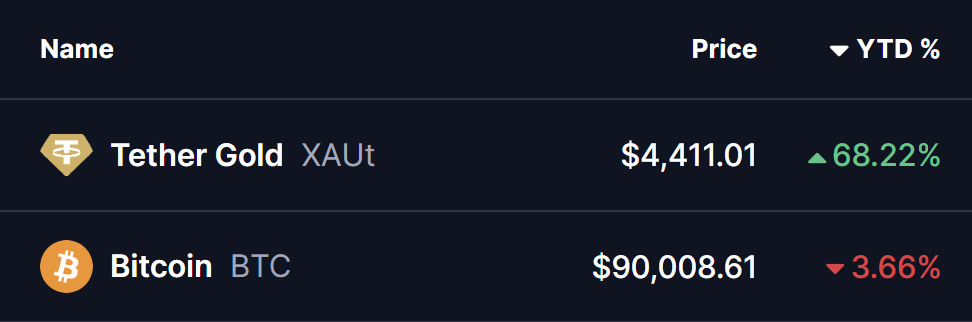
Gold has officially punched through the $4,400 mark, hitting a fresh all-time high of $4,421 today, December 22, 2025. This historic move crowns a blistering year for the “yellow metal,” which is now up over 68% in 2025 while **Bitcoin (BTC),** often called Digital Gold, is down 3.79% this year.
While gold dominates the headlines, seasoned analysts are looking at a different chart: The Bitcoin-to-Gold Fractal. Historically, Bitcoin doesn’t move with gold—it follows it with a strategic delay.
Source: Coinmarketcap
Historical Gold Fractal Hints at Bullish Potential
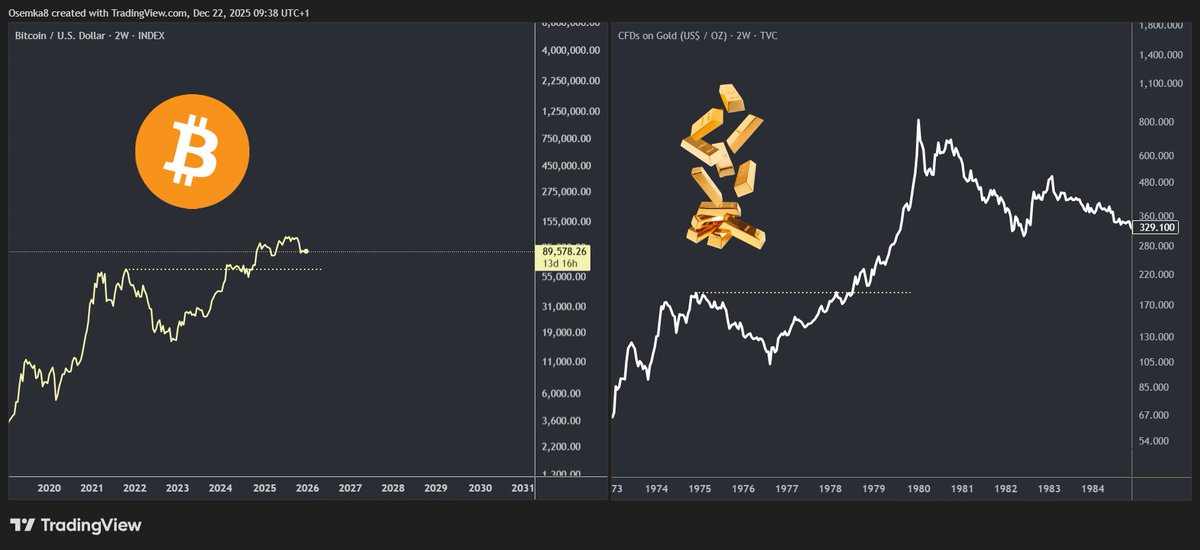
The latest analysis shared by crypto analyst @Osemka8 highlights how Bitcoin’s current price action closely mirrors the structure that played out for gold during the 1970s.
Back then, gold experienced a strong initial rally, followed by a multi-year consolidation phase that frustrated investors and created doubts about further upside. That pause ultimately proved to be a launchpad, as gold later entered a parabolic expansion phase that redefined its valuation for decades.
When overlaying Bitcoin’s long-term chart against gold’s historical fractal, the similarities become difficult to ignore. Bitcoin’s rise from its early-cycle lows mirrors gold’s initial breakout phase, while the current multi-month consolidation near the $85,000–$90,000 range closely aligns with gold’s mid-cycle pause before its next leg higher.
BTC-GOLD Fractal Chart/Credits: @Osemka8 (X)
The chart suggests that Bitcoin is not breaking down — it is digesting gains, much like gold did before its historic surge.
Bitcoin’s Consolidation May Be Strength, Not Weakness
Despite gold stealing the spotlight, Bitcoin has quietly maintained a higher-timeframe structure of higher highs and higher lows. The recent correction from the $120,000 region appears more consistent with a macro reset than a trend reversal.
Much like gold in the 1970s, Bitcoin’s current range-bound behavior may be acting as a transfer of supply from short-term traders to longer-term holders. This phase often feels slow and unconvincing, but historically, it has preceded some of Bitcoin’s strongest expansion moves.
Another key similarity lies in relative underperformance. In past cycles, Bitcoin has often lagged traditional hedges during periods of macro uncertainty, only to later outperform them once confidence returns and liquidity expands.
What’s Next for BTC?
If the gold-to-Bitcoin fractal continues to play out, Bitcoin’s current consolidation could represent the final base before a renewed upside phase. A sustained break above the upper consolidation range would likely shift sentiment rapidly, opening the door for a broader trend continuation toward new highs.
That said, fractals are not guarantees. They serve as historical context rather than precise forecasts. Timing, macro liquidity conditions, and investor sentiment will all play critical roles in determining whether Bitcoin follows gold’s historic footsteps.
For now, the chart delivers a clear message: gold has already moved — and Bitcoin may simply be next in line.
Disclaimer: The views and analysis presented in this article are for informational purposes only and reflect the author’s perspective, not financial advice. Technical patterns and indicators discussed are subject to market volatility and may or may not yield the anticipated results. Investors are advised to exercise caution, conduct independent research, and make decisions aligned with their individual risk tolerance.
Disclaimer: The information on this page may come from third parties and does not represent the views or opinions of Gate. The content displayed on this page is for reference only and does not constitute any financial, investment, or legal advice. Gate does not guarantee the accuracy or completeness of the information and shall not be liable for any losses arising from the use of this information. Virtual asset investments carry high risks and are subject to significant price volatility. You may lose all of your invested principal. Please fully understand the relevant risks and make prudent decisions based on your own financial situation and risk tolerance. For details, please refer to
Disclaimer.
Related Articles
Data: BTC breaks through $74,643, with the liquidation strength of major CEX short positions reaching $1.842 billion
Gate News reports that on March 19, according to Coinglass data, if BTC breaks through $74,643, the cumulative short liquidation intensity across mainstream CEX will reach $1.842 billion. Conversely, if BTC falls below $67,727, the cumulative long liquidation intensity across mainstream CEX will reach $1.172 billion.
GateNews3m ago
ETF Absorbs Over $1.1 Billion Yet Struggles to Rescue the Market? Powell and Oil Prices Team Up to Put Pressure On, Bitcoin Breaks Key Support
Despite Bitcoin ETF inflows of $1.16 billion, Bitcoin price pulled back to $71,000, declining over 4%. Analysts attribute the pullback to interest rate expectations and inflation pressures, while ETF inflows indicate that institutions view Bitcoin as a long-term asset. The weakness in U.S. equities has also impacted the crypto market.
GateNews50m ago
Gold and Bitcoin decline simultaneously by 3.6% and 4.6%, respectively, as the global market faces stagflation shocks.
On March 19, escalating geopolitical conflicts and hawkish Federal Reserve policies exposed global markets to stagflation pressures driven by oil. Rising oil prices, coupled with declining equities and metals, also impacted cryptocurrencies. Macroeconomic dynamics revealed intensifying energy tensions and widespread risk-averse sentiment across markets.
GateNews59m ago
Bank of Japan Holds Steady: Takaichi Calls for Caution, Iran Conflict May Increase Inflation Pressure
The Bank of Japan maintains its benchmark interest rate at 0.75% unchanged, while warning that the Iran conflict could push up energy prices and create inflationary pressure. In the short term, inflation may fall below 2%, but the Middle East situation and rising oil prices could continue to impact prices. Markets are focused on wage negotiation progress, as wage growth will affect future rate hike decisions.
GateNews1h ago


