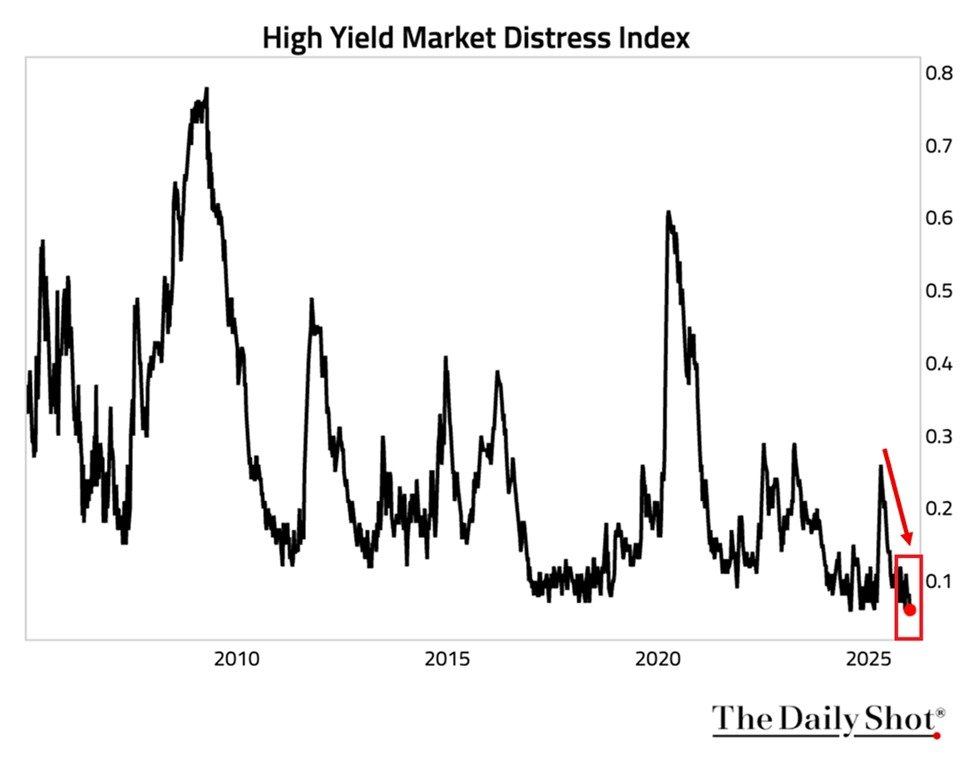
US credit market health has reached unprecedented strength, with the New York Fed high-yield distress index plunging to an all-time low of 0.06, signaling the most benign corporate borrowing conditions and junk bond market liquidity in history.
(Sources: DailyShot News)
Yet this abundance of risk appetite macro has failed to flow into cryptocurrency, leaving Bitcoin in extended consolidation near $91,000. This analyst insight examines the paradox of credit markets at record health amid stagnant crypto inflows, on-chain signals, institutional holder behavior, and potential catalysts for change as of January 8, 2026.
Measuring US Credit Market Health: The New York Fed High-Yield Distress Index
The New York Fed high-yield distress index tracks stress in the junk bond segment through liquidity, market functioning, and borrowing ease. Its drop to 0.06—far below 0.60 (2020 pandemic) and 0.80 (2008 crisis)—confirms exceptional junk bond market liquidity and corporate borrowing conditions.
High-yield ETF HYG delivered ~9% returns in 2025, marking a third consecutive strong year and underscoring broad risk appetite macro.
- All-Time Low: 0.06 on the distress index.
- Historical Comparison: Well below prior crisis peaks.
- ETF Performance: HYG reflecting sustained investor confidence.
- Macro Implication: Abundant systemic liquidity with minimal perceived default risk.
Liquidity Abundance vs. Crypto Starvation: The Paradox in Risk Appetite Macro
Despite credit markets at record health, capital has rotated preferentially to equities and gold rather than digital assets. CryptoQuant data shows Bitcoin inflows “dried up,” with risk appetite macro favoring traditional risk-on plays like AI-driven Big Tech stocks near all-time highs.
This hierarchy places crypto downstream in allocation decisions, creating a disconnect where healthy corporate borrowing conditions and junk bond market liquidity fail to spill over.
- Capital Rotation: Equities and precious metals absorbing flows.
- Crypto Inflows: Notably absent despite macro tailwinds.
- Institutional Preference: Risk-adjusted returns favoring non-crypto assets.
- Paradox Core: Liquidity plentiful, but not reaching Bitcoin.
On-Chain and Derivatives Signals Amid Credit Markets at Record Health
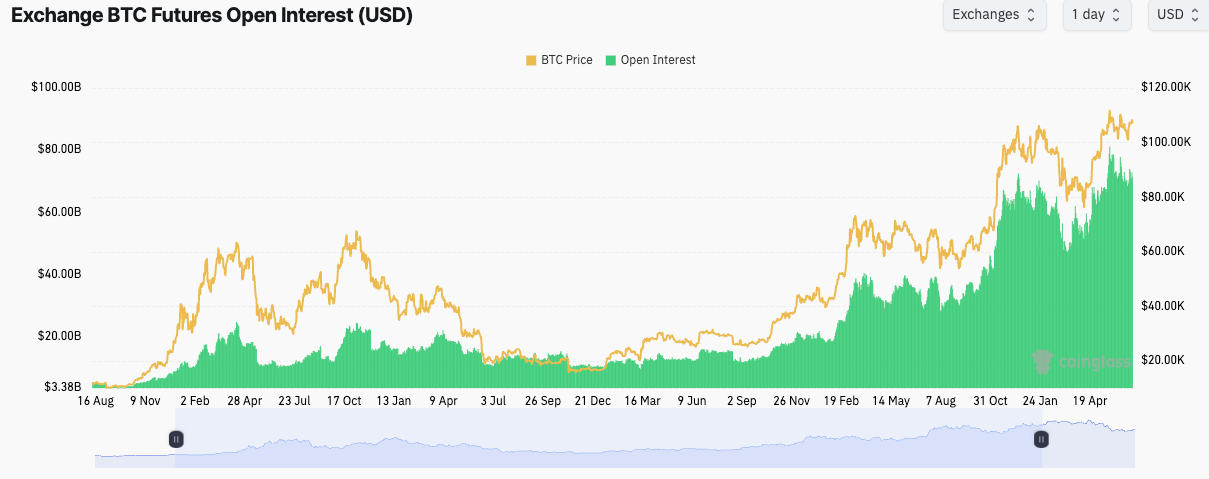
Bitcoin futures open interest stands at $61.76 billion across 679,120 BTC (+3.04% daily), led by Binance ($11.88B), CME ($10.32B), and Bybit ($5.90B). Price remains range-bound near $91,000 with $89,000 support, reflecting hedging rather than directional bets.
(Sources: coinglass)
Institutional long-term holders like MicroStrategy (673,000 BTC) exhibit minimal selling, compressing volatility and reducing crash probability.
- OI Stability: Steady positioning without aggressive longs/shorts.
- Holder Behavior: Patient capital via ETFs and corporates.
- Volatility Outlook: Sideways consolidation over sharp moves.
- Crash Likelihood: Low due to absent panic selling pressure.
Potential Catalysts to Resolve the Liquidity Paradox
Several triggers could redirect risk appetite macro toward crypto:
- Equity overvaluation prompting rotation to alternatives.
- More aggressive Fed easing amplifying broad risk-taking.
- Regulatory advancements lowering institutional barriers.
- Bitcoin-specific developments (post-halving supply, ETF options).
Absent these, extended sideways action remains the base case.
- Bull Triggers: Valuation extremes or policy shifts.
- Current State: Healthy but stagnant crypto market.
- Consensus View: Boring consolidation likely near-term.
In summary, US credit market health and credit markets at record health—evidenced by the New York Fed high-yield distress index at historic lows—highlight abundant junk bond market liquidity and favorable corporate borrowing conditions, yet fail to propel Bitcoin amid preferential flows to equities and gold. Strong risk appetite macro exists systemically, but crypto remains sidelined, supported by institutional restraint that limits downside while capping upside momentum. This liquidity paradox suggests consolidation persists until clearer rotation catalysts emerge. Monitor equity valuations, Fed signals, and on-chain inflows for potential shifts—always reference primary macro data and regulated sources when assessing cross-asset dynamics.
Disclaimer: The information on this page may come from third parties and does not represent the views or opinions of Gate. The content displayed on this page is for reference only and does not constitute any financial, investment, or legal advice. Gate does not guarantee the accuracy or completeness of the information and shall not be liable for any losses arising from the use of this information. Virtual asset investments carry high risks and are subject to significant price volatility. You may lose all of your invested principal. Please fully understand the relevant risks and make prudent decisions based on your own financial situation and risk tolerance. For details, please refer to
Disclaimer.
Related Articles
Trump Establishes Strait of Hormuz Alliance, Bitcoin Surges Past $74,000
Affected by geopolitical news, Bitcoin rose during Asian trading hours, reaching a high of $74,309, with the market focusing on the $74,000 breakthrough. Trump's plan to form a multinational coalition to address Iranian oil exports may drive Bitcoin further higher. Since the conflict, BTC price has rebounded 11%.
GateNews9m ago
BTC 15-minute decline of 0.67%: Exchange net inflows increase and futures long liquidation resonance intensifies volatility
On 2026-03-16 06:00 to 06:15 (UTC), BTC experienced a short-term decline with a 15-minute return rate of -0.67%, price range between 73610.0 and 74204.0 USDT, with a volatility amplitude of 0.80%. This price movement drew market attention; while the fluctuation magnitude is at typical Bitcoin levels, it has received high discussion volume given the recent stable market conditions.
The main driver of this price movement was a slight increase in BTC net inflows on mainstream trading platforms, with some coin holders transferring assets to exchanges during this period, combined with long position stop-losses and active position reduction in the futures market, which triggered
GateNews23m ago
Adam Back Warns BIP-110 Proposal May Suppress Bitcoin's Upgrade Capabilities
Bitcoin Improvement Proposal BIP-110 discussions are heating up. The proposal aims to clean up on-chain data but has sparked controversy. It would disable important opcodes and limit control block sizes, potentially impacting future technological development. Despite being positioned as a temporary measure, long-term upgrade restrictions could pose risks.
GateNews24m ago
Michael Saylor Hints at Another Strategy Bitcoin Buy as Crypto Leaders Reject Boris Johnson's 'Ponzi' Claim
Strategy co-founder Michael Saylor hinted on March 15, 2026, at another potential Bitcoin purchase by the company, posting "Stretch the Orange Dots" on X in a recurring pattern that has preceded 11 previous acquisition announcements in 2026.
CryptopulseElite56m ago


