Key Insights:
- The South Korean Supreme Court has now officially classified Bitcoin held on digital exchanges as seizable property under criminal law.
- This ruling clarifies that investigators can seize electronic information with economic value just like physical objects.
- Legal precedents in South Korea and the UK are moving toward treating crypto with the same status as traditional assets.
South Korea recently made a major legal move that changes how digital assets work in the courtroom. The country’s Supreme Court ruled that Bitcoin on exchanges can be seized during criminal investigations.
This decision ends a long debate over whether digital tokens count as physical property. Judges decided that even though you cannot touch a digital coin, its value is very real.
Understanding the Ruling for Bitcoin on Exchanges Can Be Seized
The case centred on a person known only as Mr. A.
Authorities caught him during a money-laundering investigation and seized 55.6 Bitcoin from his exchange account. At the time, that stash was worth about $413,000. Mr. A fought back, claiming the police had no right to take his data.
He also argued that the law only allows for the seizure of physical objects.
However, the Supreme Court did not agree with Mr A’s logic. They looked at the Criminal Procedure Act and found that it covers more than just boxes of cash or cars. The court also stated that seizure targets include both tangible objects and electronic information.
This means that Bitcoin on exchanges can be seized because it functions as an electronic token that people manage and trade.
The judges explained that Bitcoin has economic value that people can control. Because anyone can trade it for goods or other currencies, it fits the legal definition of an asset.
The Positives of the New Seizure Rules
This ruling brings much-needed clarity to the digital space. For years, criminals used the “it is not a physical object” excuse to protect their stolen wealth.
Now, prosecutors have a clear green light to go after illicit funds. This could make South Korea a safer place for honest crypto users. It also shows that the government is serious about cleaning up fraud and money laundering.
Clearer rules also help the industry grow in the long run. When the law recognises Bitcoin as property, it gives it more legitimacy.
This makes it easier for insurance companies and banks to handle digital assets. If the law protects a person’s right to own it, it must also allow the state to take it if this individual breaks the rules.
The Negatives of Increasing Government Control
Some privacy advocates have expressed worry about this trend. They feel that if Bitcoin on exchanges can be seized easily, it gives the government too much power.
Unlike a physical house, digital data is easy to move or freeze with a few clicks. There are concerns that innocent people might even have their accounts locked during general investigations.
There is also the issue of exchange security. If a court orders an exchange to hand over funds, the exchange must comply.
This removes the “middleman” protection that some users expect. It also reminds everyone that “not your keys, not your coins” is a very real concept. If your Bitcoin sits on a platform, you do not have total control over it in a legal fight.
South Korea Joins a Global Legal Trend
South Korea is not the only nation moving in this direction. Just last month, the UK passed a law that officially calls digital assets “property.”
BREAKING: 🇬🇧 UK passes law officially recognising crypto as property. pic.twitter.com/d7HvkUyFEG
— Bitcoin Magazine (@BitcoinMagazine) December 3, 2025
This gives crypto the same legal status as a house or a car in British courts. Governments everywhere are realising that they cannot ignore billions of dollars just because they exist as code.
The move in Seoul came after a string of high-profile crypto crimes. One exchange operator recently got four years in prison for trying to sell secrets for Bitcoin.
As these crimes become more common, the legal system must adapt. In all, this ruling makes sure that the law keeps up with technology instead of falling behind.
Bitcoin’s Performance In View
Bitcoin now trades around the $90,000 zone, despite ETF outflows recently hitting the $380 million mark.
According to data from CoinMarketCap, the cryptocurrency is up by around 0.3% over the last 24 hours.
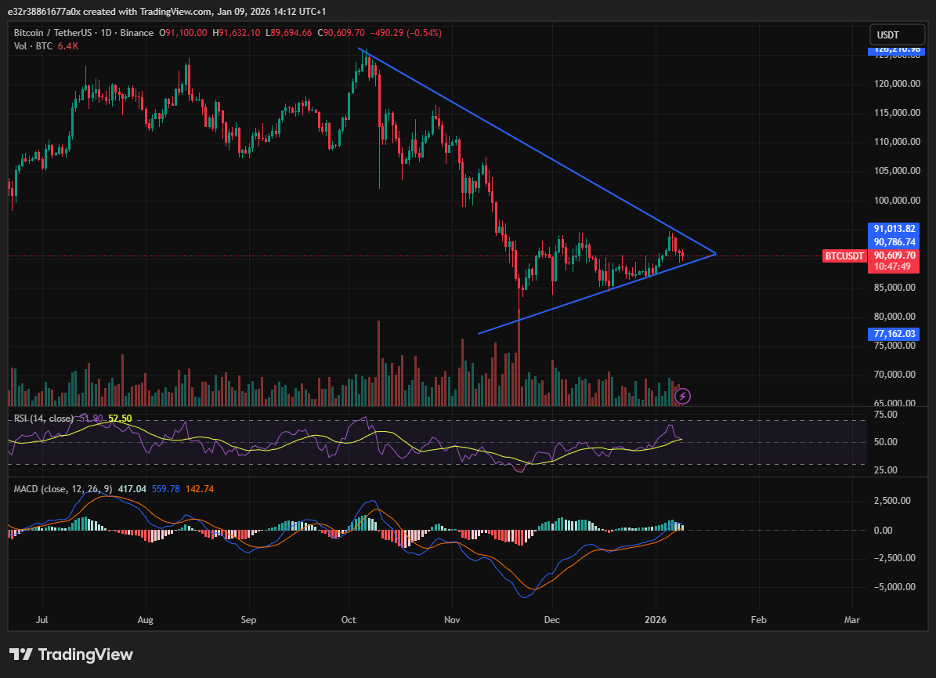 Bitcoin trades in a symmetrical triangle on the daily charts, source: TradingView
On the daily charts, BTC is coiling into a symmetrical triangle, which is defined by a descending trendline from the $107k high.
The support zone for this formation sits somewhere around the $80.5k zone. Investors are now watching the next major resistance zones for the cryptocurrency around $94,000 and then $97,400.
In other words, a close above the $94,000 zone with a daily candlestick would result in a price explosion towards the upside.
Disclaimer: The information on this page may come from third parties and does not represent the views or opinions of Gate. The content displayed on this page is for reference only and does not constitute any financial, investment, or legal advice. Gate does not guarantee the accuracy or completeness of the information and shall not be liable for any losses arising from the use of this information. Virtual asset investments carry high risks and are subject to significant price volatility. You may lose all of your invested principal. Please fully understand the relevant risks and make prudent decisions based on your own financial situation and risk tolerance. For details, please refer to
Disclaimer.


