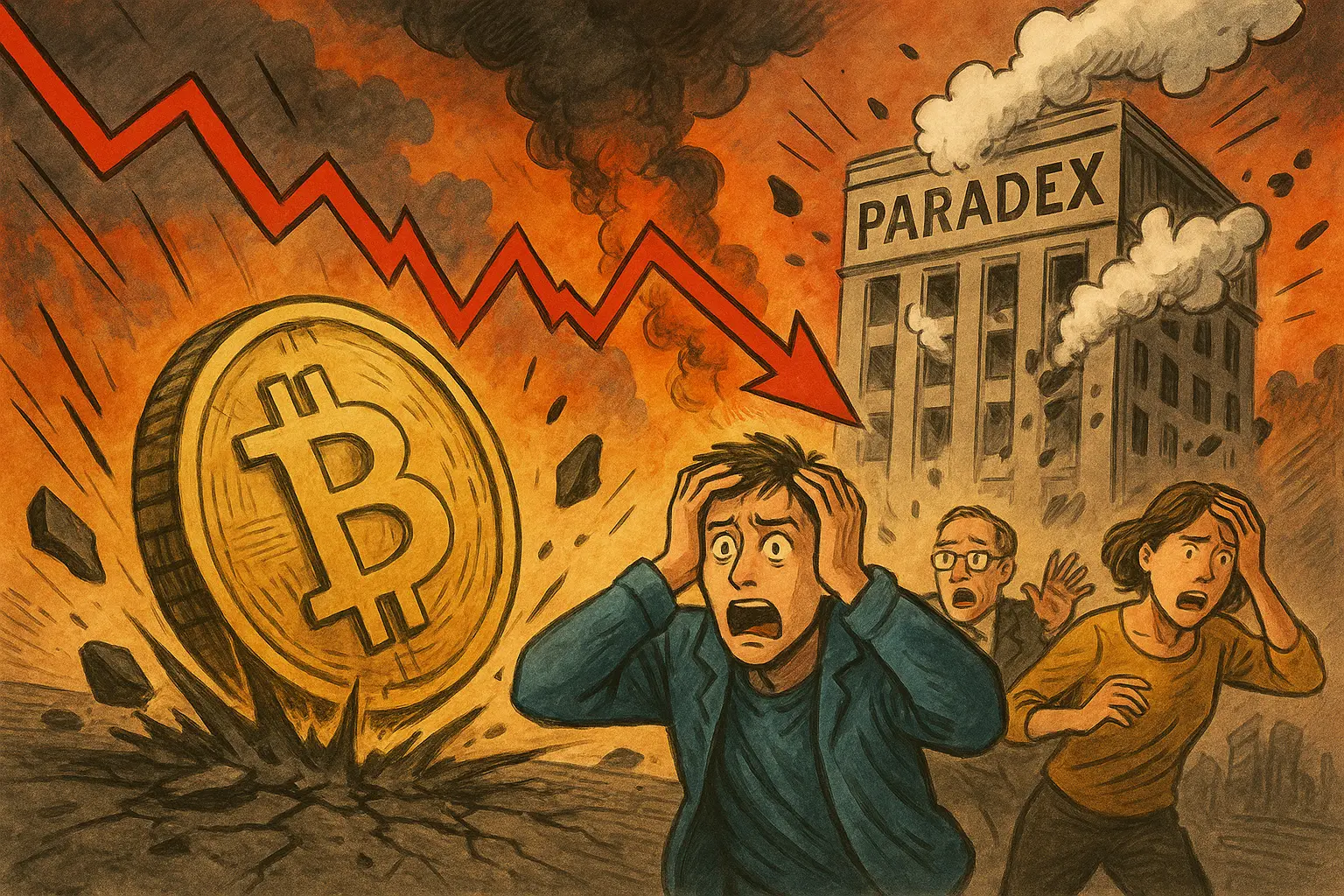
Paradex on January 19th early morning experienced a database migration failure that caused Bitcoin prices to plummet to $0, triggering massive liquidations. The issue first appeared at 12:36 AM Eastern Time, when Bitcoin’s price on the exchange hit zero, causing a chain of liquidations. The platform urgently rolled back to block 1604710 to restore the state. DeFiLlama data shows the platform’s open contracts reached $641 million, with a monthly trading volume of $37 billion.
Paradex Database Migration Failure Causes Bitcoin Price to Drop to $0
According to numerous user reports, due to database migration issues affecting Paradex blockchain, its block explorer, bridge, and API, Bitcoin’s price on the decentralized exchange Paradex suddenly dropped to $0 overnight. At 12:36 AM ET Monday, the Paradex status page first showed problems. Shortly before, social media posts indicated that as Bitcoin’s price on the platform plummeted to $0, a series of liquidations occurred.
Footage viewed by DL News shows that around 4:30 AM London time, shortly after maintenance, thousands of trades on the platform were liquidated within seconds. This sudden price collapse triggered a catastrophic chain reaction because perpetual contract exchanges’ liquidation mechanisms are automated; once collateral value hits zero, the system automatically forces liquidation of all positions.
Database migration is a common technical maintenance operation in blockchain projects, aimed at improving performance or expanding capacity. However, Paradex’s migration evidently contained serious technical errors, causing the price database to fall out of sync with actual market data. When the system erroneously read Bitcoin’s price as $0, all positions using Bitcoin as collateral were deemed undercollateralized, triggering forced liquidation.
Paradex Incident Timeline
12:36 AM ET: Status page first shows issues, database migration begins
Around 2:00 AM: Exchange detects problems and begins repair efforts
5:16 AM: Confirmed all user funds are safe, recovery underway
A few hours later: All Paradex services restored
This technical failure is catastrophic for an exchange handling $641 million in open contracts. The total liquidation amount remains unclear, but DeFiLlama data shows the protocol’s open contracts are about $641 million. The protocol facilitated approximately $37 billion in trading volume over the past 30 days. If most positions were liquidated during the failure, the losses could be enormous.
Blockchain Rollback Sparks Decentralization Controversy
Around 2:00 AM ET, the exchange discovered issues and began implementing a fix, leading to a rollback of the Paradex Chain (a blockchain built on Starknet technology). Starknet is an Ethereum layer-2 scaling network. “We have identified the problem and will roll back the blockchain state to block 1604710,” the update stated. “This is the state before the database maintenance and the last known correct state. All accounts will be restored to the state prior to the maintenance.”
Blockchain rollback is highly controversial. One of blockchain’s core values is immutability; once a transaction is on-chain, it should be a permanent record. However, when technical failures cause severe errors, projects face a dilemma: either uphold the immutability principle and accept the erroneous liquidation as final, or perform a rollback to restore the state before the fault, which contradicts blockchain’s fundamental principles.
For blockchain projects, rollback is usually a last resort, as it undermines the core purpose of providing a single, consistent, and immutable shared ledger. This incident has shaken investor confidence in Paradex, which aims to offer zero-fee, highly liquid, and private perpetual asset trading.
Paradex CTO Clement Ho posted on Discord to reassure panicked users. Soon after, Paradex forcibly canceled all remaining open orders and confirmed around 5:00 AM ET that all user funds were safe as the recovery process was ongoing. “Recovery work is in progress. We can confirm all user funds are safe,” a message on the status page read at 5:16 AM ET. According to updates on the status page, all Paradex services are now operational again.
From the outcome, Paradex appears to have prioritized user interests. Through rollback, users who were wrongly liquidated due to the fault could be restored to the pre-failure state, avoiding unjust losses. However, this operation also raises questions about true decentralization: a supposedly decentralized exchange that can unilaterally rollback blockchain state—how is that different in essence from a centralized exchange?
Paradigm Background and Risks of Perpetual Contract Exchanges
The platform was incubated by the institutional crypto derivatives liquidity network Paradigm, not the venture capital firm of the same name. In 2021, Paradigm raised $35 million from investors including Jump Capital, Alameda Ventures, Genesis, and Nexo, with a valuation of $400 million. These investors’ names now seem somewhat ironic: Alameda Ventures is linked to the now-defunct FTX, Genesis filed for bankruptcy in 2023, and early backers’ fates highlight the high-risk nature of the crypto market.
Paradex is not the first perpetual contract platform to encounter issues in recent months. Hyperliquid, the largest perpetual futures platform by 30-day trading volume, lost tens of millions of dollars over the past year due to attacks by large traders. In August, a trader inflated the value of XPL token futures contracts by 200%, profiting $15 million and causing significant losses to others.
These events reveal the systemic risks inherent in perpetual contract exchanges. Unlike spot trading, perpetual contracts allow high leverage, meaning small price movements can trigger large-scale liquidations. When technical failures or market manipulation cause abnormal prices, the liquidation mechanism amplifies losses. For Paradex, Bitcoin dropping to zero is the most extreme scenario, instantly rendering all BTC collateralized positions underwater.
It remains unclear when users’ funds trapped on Paradex will be recoverable. Paradex stated: “Due to the complexity of the recovery process, we cannot specify a precise timeline. We will update promptly with any developments.” This uncertainty further erodes user confidence, with many likely to withdraw immediately once funds are unfrozen.
Price Failure Occurred After Bitcoin Market Volatility
The exchange’s price failure happened after Bitcoin experienced sharp volatility. Sunday night, just after 7 PM, Bitcoin’s price fell from over $95,000 to $92,284. The 2% drop in 24 hours erased this week’s gains for the top crypto asset, with Bitcoin’s weekly increase now at 1.4%, trading at $93,318.
This decline triggered increasing liquidations, with over $875 million in liquidations in the past 24 hours—according to CoinGlass data, $234 million of which was due to Bitcoin. The market volatility provides context for Paradex’s failure: amid already turbulent markets, technical issues compounded the chaos, turning normal market adjustments into catastrophic liquidation events.
For users, this incident offers a painful lesson. First, do not keep all funds on a single exchange, especially newer or smaller platforms. Second, when using high-leverage contracts, set reasonable stop-losses and maintain sufficient margin to avoid forced liquidation during abnormal price swings. Third, be cautious of so-called “decentralized” exchanges, as Paradex’s case shows they can still make centralized decisions at critical moments.
Industry-wise, this event may push perpetual contract exchanges to strengthen technical audits and risk controls. Critical operations like database migrations should be thoroughly tested in staging environments with multiple safety checks. When abnormal price data occurs, systems should automatically halt trading rather than continue with liquidations. These technical improvements are vital for enhancing the overall reliability of the industry.


