In April 2024, the CryptoPunk NFT numbered 3100 was bought by a user for $16 million (4,500 ETH), ranking as the third highest price transaction for a single NFT. On April 10, 2025, this CryptoPunk was sold for $6 million (4,000 ETH), resulting in a loss of $10 million compared to the purchase price a year earlier.
Part of the losses can be attributed to the decline in Ethereum prices caused by fluctuations in the macroeconomic environment due to the U.S. “reciprocal tariff” policy, and part can be attributed to the dismal NFT market.
Not just CryptoPunks, the trading volume of popular and high-profile NFT IPs such as Bored Ape Yacht Club, Azuki, and Pudgy Penguins has been steadily declining since 2022, especially in the particularly poor market performance in recent weeks.
Compared to the highlights of the past two years, NFTs are slowly fading from view. However, NFTs are a relatively new development. The first NFT was born about ten years ago, and it wasn't until the end of November 2017, when Ethereum launched the ERC-721 standard, that this technology began to gain public attention.
NFTs are certainly not limited to representing value as carriers of digital art; they can almost represent any unique or singular item: identity (such as Decentralized Identity DID), virtual avatars, profile pictures (PFP), personal data records, virtual real estate, artworks, assets in games or virtual worlds, music, domain names, and so on.
The core of NFT is digital ownership: as long as you own a certain NFT, you truly own the content specified in that NFT's smart contract, whether it's an image, game item, commercial rights to an asset, or various others. This “true ownership” represents an important paradigm shift in the internet world, reflecting how people used to be accustomed to using goods and services through authorization rather than directly owning them.
In other words, we have truly entered the “digital ownership era of virtual goods,” but it has only been about seven years.
Currently, we usually regard NFTs as a separate field within Web3, alongside the metaverse, cryptocurrencies, RWA, and DePIN. This perspective has both reasonable and unreasonable aspects.
In terms of its reasonable aspects, NFTs themselves can constitute a thriving NFT sector, where various virtual items are minted as NFTs through smart contracts or physical items are mapped onto the blockchain as assets, forming NFT trading markets like OpenSea and Blur.
The unreasonable part is that NFT is a tool that integrates various elements into different fields. NFTs can serve as assets in the metaverse, such as games, real estate, and items; as on-chain circulating assets for RWA; as circulating assets for DePIN project ecosystems; and as unique carriers for identity, avatars, music, videos, domain names, and data.
In the DePIN field of decentralized cloud computing power, transactions and circulation are conducted using computing power resources as carriers—computing power resources can be traded on the platform in the form of NFTs.
Industry insiders have regarded NFTs as an innovation as important as BTC. This understanding reflects that NFTs may play an increasingly important role in the future metaverse and AI era. Both the market and users need a unique, freely transferable, traceable, and secure asset carrier.
The innovative applications of NFTs demonstrate their subsequent potential more significantly compared to traditional centralized projects in the history of technology.
Apple distributes software and content for iOS devices through its closed App Store ecosystem. According to financial reports, in 2013, approximately six and a half years after the iPhone was first launched, Apple's App Store's annual sales reached about $10 billion, with December alone contributing over $1 billion.
Similarly, seven years after NFT technology entered the market, the total NFT trading volume for the year 2024 is approximately $8.9 billion, with a monthly trading volume of about $892 million in December.
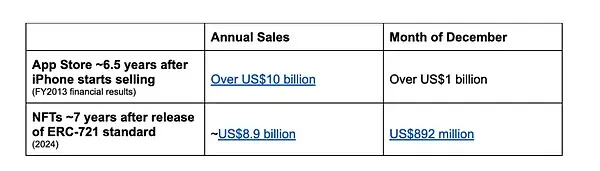
Under conditions where the time difference is not significant, the trading volume of NFTs is gradually approaching that of apples.
Interestingly, when the iPhone was first launched, it impressed people with its high price and performance, and the same goes for NFTs, with IPs like Bored Apes and CryptoPunks being valued in the tens of millions of dollars.
With the development of the market, most NFTs are not expensive and are used for various purposes. They may be combined with brands as a tool for brand community cohesion, used by traditional project parties for brand marketing, or utilized for value-added products such as tickets and IP peripherals. Following the nature of NFTs, we can continue to observe their subsequent development.
Disclaimer: The information on this page may come from third parties and does not represent the views or opinions of Gate. The content displayed on this page is for reference only and does not constitute any financial, investment, or legal advice. Gate does not guarantee the accuracy or completeness of the information and shall not be liable for any losses arising from the use of this information. Virtual asset investments carry high risks and are subject to significant price volatility. You may lose all of your invested principal. Please fully understand the relevant risks and make prudent decisions based on your own financial situation and risk tolerance. For details, please refer to
Disclaimer.
Related Articles
Polymarket data: The probability of Bitcoin reaching $80,000 in March has increased to 44%
Gate News reported that on March 17, benefiting from the recent sustained rebound in the crypto market, Polymarket prediction market data shows that the probability of Bitcoin reaching $80,000 in March has risen to 44%. At the same time, the probability of Bitcoin falling to $60,000 in March has dropped to 12%.
GateNews4m ago
Institutional Capital Inflows Drive Bitcoin ETF Six Consecutive Days of Net Inflows, BTC Price Rises Over 12% During Period
On March 17, US Bitcoin ETFs achieved net inflows for six consecutive days, with total capital reaching $962.8 million, and Bitcoin price rose more than 12%. Analysts believe that geopolitical tensions and Bitcoin's safe-haven attributes have driven institutional demand, with the market maintaining attention on its future trajectory.
GateNews27m ago
Robert Kiyosaki Warns of Global Market Crash, Bitcoin Could Soar to $750,000
"Rich Dad Poor Dad" author Robert Kiyosaki has issued another warning that global markets could crash, predicting that Bitcoin and hard assets will surge significantly. He forecasts Bitcoin could reach $750,000, emphasizing the importance of holding cash and diversifying investments to navigate market volatility.
GateNews28m ago
Macro Analysts Warn of Private Credit Crisis, Bitcoin May Become Top Safe-Haven Choice
As artificial intelligence intensifies its impact on software revenue, the private credit market faces mounting pressure with default rates climbing to 5.8%. Analysts warn that additional monetary expansion may be necessary, while Bitcoin has emerged as a hedging tool for investors, with its appeal growing amid uncertainty. The market needs to monitor developments in private credit dynamics and the impact of policy adjustments on Bitcoin's price.
GateNews30m ago
Bitcoin Surpasses $75,000: Short Liquidations Exceed $330 Million, Continuous ETF Inflows Drive Market Rally
Bitcoin's price broke through $75,000 on March 17, hitting a six-week high, accompanied by large-scale short position liquidations. Crypto market liquidations in the past 24 hours approached $498 million, with mainstream altcoins also performing strongly. Spot Bitcoin ETFs have attracted significant institutional capital inflows, boosting market confidence. Technical analysis shows Bitcoin has further upside potential, with resistance at $79,000 and support at $72,000.
GateNews37m ago


