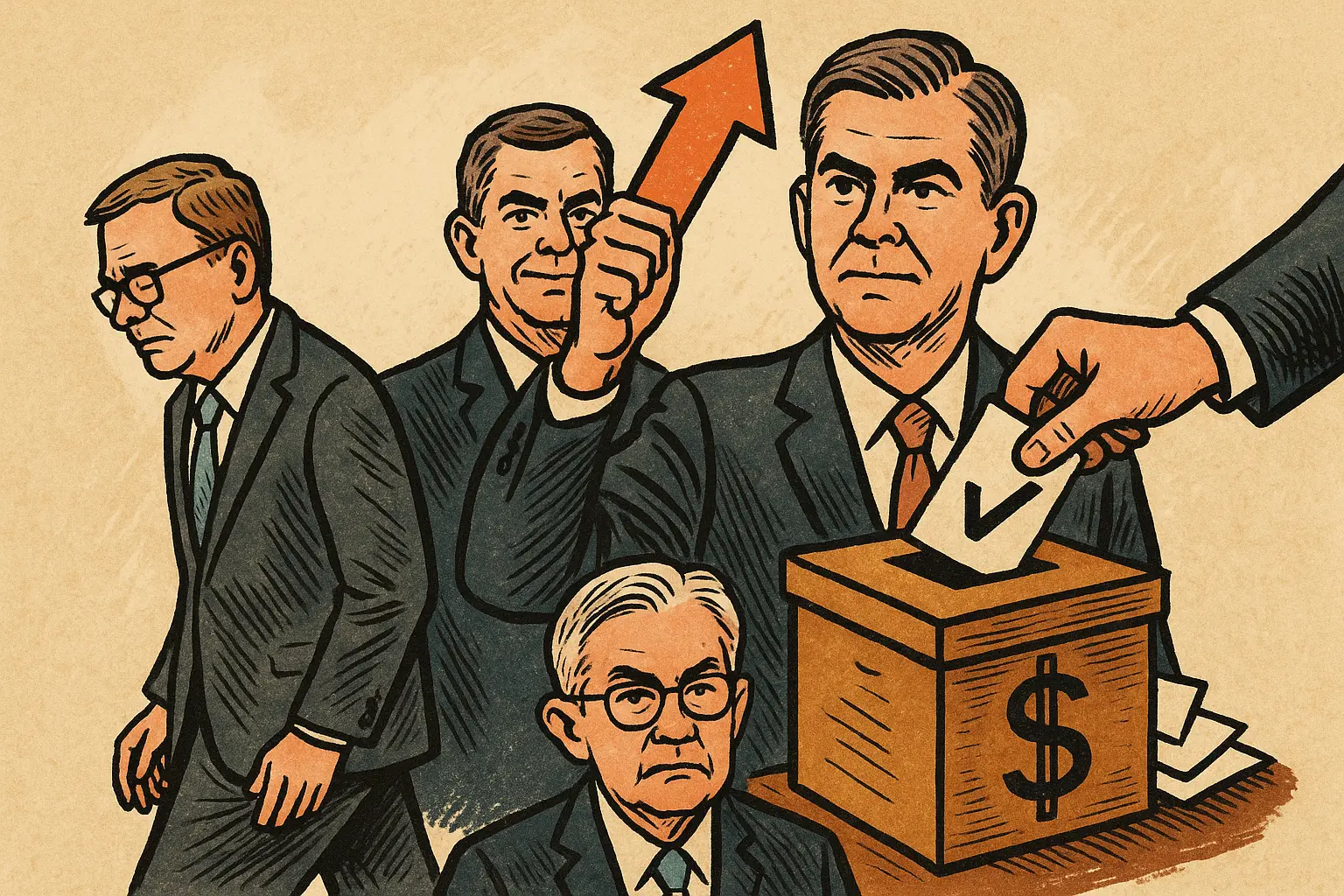
White House Chief Haspett stated that Trump hopes he will remain, and the market interpreted this as a withdrawal from the Federal Reserve Chair race. The forecast market quickly adjusted expectations, with the probability of Wosh soaring to 60%, Hasset dropping to 15-16%, and Waller around 13-14%. Wosh led for the first time, but Trump’s style remains unpredictable. Powell’s term ends on May 15.
Trump’s statement allows Haspett to continue staying in the White House, withdrawing from the race
White House economic advisor Kevin Hasset recently stated that Trump keeping him in his current position might be the right decision. Such remarks were widely interpreted by the market as him essentially losing qualification for the Federal Reserve Chair position. Hasset currently serves as the head of the National Economic Council, a core position in White House economic policy.
According to Bloomberg, Hasset claims that President Trump has not made a final decision on the position. However, the President himself has shown a clear inclination. During a recent event at the White House, the US President told Hasset that he hopes he will continue to stay in the West Wing. Trump’s comments have lowered expectations for Hasset’s appointment as the central bank’s head.
Previously, Hasset was considered one of the top contenders to succeed Jerome Powell. During Trump’s first term, he served as chairman of the White House Economic Advisory Council and had an in-depth understanding of Trump’s economic policies. However, Trump’s latest public statements essentially mark Hasset’s withdrawal from the race.
Hasset himself denies feeling disappointed about not being promoted. He claims that being appointed at the White House is still an important position. He praised Trump’s words as commendations and expressed gratitude. This public stance also provides a dignified exit for him.
Wosh’s winning probability surges to 60%, becoming the clear front-runner
After Trump publicly sent the above signals, the forecast market quickly adjusted expectations. Data from two major prediction platforms, Kalshi and Polymarket, show that the probability of former Fed Governor Kevin Wosh becoming the next Fed Chair has surged to about 60%, clearly leading other candidates. In comparison, Hasset’s chance has fallen to about 15-16%, with incumbent board member Christopher Waller around 13-14%.
This is a significant change. Previously, Wosh and Hasset were neck and neck, with both having win probabilities fluctuating between 30-40%. But as Hasset essentially exited the race, Wosh’s advantage rapidly expanded, making him the “clear front-runner” for the first time. Analysts note that a 60% chance indicates the market believes Wosh has over a fifty percent chance of being nominated.
Kevin Wosh served as a Federal Reserve governor from 2006 to 2011 and is an experienced central banker. His performance during the financial crisis was recognized by the market, and he maintains good relations with Wall Street. After leaving the Fed, he transitioned into academia and is now a visiting scholar at Stanford University’s Hoover Institution, with his views on monetary policy frequently cited.
However, analysts also warn that although Wosh is currently leading, Trump’s style on personnel matters is highly unpredictable, and the final outcome remains uncertain. Trump has changed personnel decisions multiple times at the last minute in the past, making predictions difficult. Additionally, Senate confirmation procedures could also influence the final candidate.
Waller and Reed form a three-way competition
Now, the Fed Chair race is viewed as a contest among Kevin Wosh, Christopher Waller, and Rick Reade. Attention has shifted from Hasset to these potential candidates with financial market backgrounds.
Christopher Waller is a current Fed governor with extensive experience in monetary policy formulation. He previously served as the head of research at the St. Louis Federal Reserve Bank and is a technically skilled central banker. His advantage lies in his familiarity with the Fed’s internal operations and having been confirmed by the Senate. However, the market’s forecast assigns him only about a 13-14% chance, indicating a relatively small likelihood.
Rick Reade is a senior managing director at BlackRock, responsible for the fixed income division. Bloomberg quoted multiple insiders saying that Reade has support in the Fed Chair selection process partly because he might face fewer obstacles in Senate confirmation. As a seasoned Wall Street figure, Reade has deep understanding of financial markets, aligning with Trump’s preference for appointing a market-experienced central banker.
Comparison of the strengths and weaknesses of the three main candidates
Kevin Wosh: Former Fed governor, high recognition on Wall Street, leading 60% chance, but has been out of the Fed for a long time
Christopher Waller: Current governor, familiar with internal operations, strong technical skills, but lower market attention, only 13-14% chance
Rick Reade: BlackRock senior executive with rich market experience, possibly fewer Senate confirmation hurdles, but lacks direct central bank experience
Treasury Secretary Steven Mnuchin is closely watching the Fed Chair selection. He has announced his withdrawal from the race and stated that the Senate is expected to accept Trump’s final nominee. Mnuchin downplays the impact of judicial investigations, saying the market overall remains stable.
Judicial investigations add variables to the Chair selection
The judicial investigation surrounding the Fed headquarters renovation plan has added unexpected variables to the Chair race and rekindled market concerns over the Fed’s independence. Fed Chair Powell has been investigated over the Fed headquarters renovation project, sparking strong backlash.
Powell strongly criticized the investigation. He believes this move is aimed at pressuring the Fed to lower interest rates. This public conflict highlights tensions between the Trump administration and the Fed. Lawmakers also responded strongly, with Senate Banking Committee members threatening that future nominees will face many tough questions.
These events intensify the competition for Trump’s next appointee. The Trump administration needs to balance market confidence with political realism. On one hand, markets want to see an independent, professional central bank leader; on the other, Trump wants to appoint someone aligned with his economic policies.
The judicial investigation also influences candidate selection. Market analysis suggests that candidates who can demonstrate independence commitments during Senate confirmation may garner more support. This is one reason why Rick Reade’s voice is rising, as his Wall Street background might make it easier for him to emphasize market principles and independence during confirmation hearings.
May 15 deadline approaching, Trump to announce within this month
Current Fed Chair Powell’s term ends on May 15. Trump has said he will announce a successor within this month but has not provided a specific timetable. As the Fed Chair term nears its end, markets are closely watching developments.
Time pressure is mounting. Nomination and Senate confirmation usually take several weeks. If Trump wants the new Chair to seamlessly succeed Powell at the end of his term, he needs to decide quickly. However, considering the judicial investigations and the complex political environment, the process could take longer than expected.
The next Fed Chair will influence interest rate policies during a critical period for the US economy. Currently, the US faces a complex situation with inflation cooling but still above target, economic growth slowing but not yet in recession. The new Chair will need to balance controlling inflation with supporting economic growth, which will be a challenging task.
Related Articles
U.S. Energy Secretary: Iran Conflict Will End Within Weeks, Prices Will Fall After Supply Rebound
Trump administration officials expect the Iran conflict to conclude within weeks, with Energy Secretary Wright stating this will lead to a supply rebound and price decline, while the White House economic director predicts positive global economic impacts. Despite short-term economic pain, this impact is worth bearing compared to nuclear weapons threats. Meanwhile, Israeli military indicates operations are planned to continue for at least three more weeks.
GateNews1h ago
ETH Drops 1.07% in 15 Minutes: Large Transfers and Long Liquidations Drive Market Action
From 2026-03-15 23:15 to 2026-03-15 23:30 (UTC), ETH (Ethereum) experienced moderate-intensity price volatility, with a 15-minute interval return rate of -1.07%. The price fluctuated between 2172.55 and 2199.76 USDT, with amplitude reaching 1.24%. Market attention showed a phased increase, and short-term volatility noticeably intensified.
The primary driver of this volatility stemmed from large on-chain fund transfers flowing into a mainstream exchange, with suspected institutional or whale activity completing multiple transactions exceeding 10,00
GateNews2h ago
IEA Announces Release of Emergency Oil Reserves, Asia-Pacific Inventory Immediately Available
Gate News reported that on March 15, the International Energy Agency (IEA, an international organization responsible for coordinating energy policies among member states) stated that oil from the IEA's emergency reserves will soon begin flowing into global markets. Inventory from Asian and Oceanian countries will be immediately available for use, while inventory from European and American countries will be available by the end of March.
GateNews10h ago
US Energy Secretary: Iran Conflict Will End in "Coming Weeks," Oil Supply Will Recover
Gate News reported that on March 15, U.S. Energy Secretary Wright stated in an interview with ABC News that the Iran conflict will end "in the coming weeks," after which oil supply will recover and energy prices will decline.
GateNews12h ago
DeFi enters a "winter of yields": liquidity stagnation, leverage contraction, and the disappearance of arbitrage opportunities
Since September 2025, the DeFi market has entered a "interest rate winter," with the annualized deposit yields of mainstream stablecoins dropping to lows, and supply and demand imbalances causing excess liquidity. As borrowing demand declines, stablecoin lending rates have also decreased, and the reduced risk appetite in the crypto market has led investors to shift toward more stable assets. Some protocols, such as Sky, offer stable returns through real-world assets, but the overall trend still indicates a period of adjustment and structural reform in DeFi.
区块客13h ago
Tom Lee: Rising oil prices are relatively bullish for US stocks; the US stock market may bottom out this month.
BitMine Chairman Tom Lee stated in an interview that rising oil prices are beneficial for the U.S. stock market, and investors tend to hold growth stocks, particularly the Magnificent 7. He believes the U.S. stock market may be forming a bottom and pointed out that current private credit issues will not lead to systemic risk.
GateNews15h ago


