The CFTC revised guidelines to include national trust banks issuing stablecoins, aligning with the GENIUS Act, and anchoring with the FDIC framework, excluding algorithmic stablecoins.
CFTC Revises Staff Letter, Officially Incorporates National Trust Banks into the Issuer Framework
The U.S. Commodity Futures Trading Commission (CFTC) issued an important update to its guidelines on February 6, 2026, officially revising the previous staff letter to fully align with the regulatory framework established by the GENIUS Act. The core of this revision is to expand the standards for payment stablecoin issuers, explicitly including National Trust Banks in the list of qualified financial institutions, granting them the legal status to issue fiat-pegged tokens.
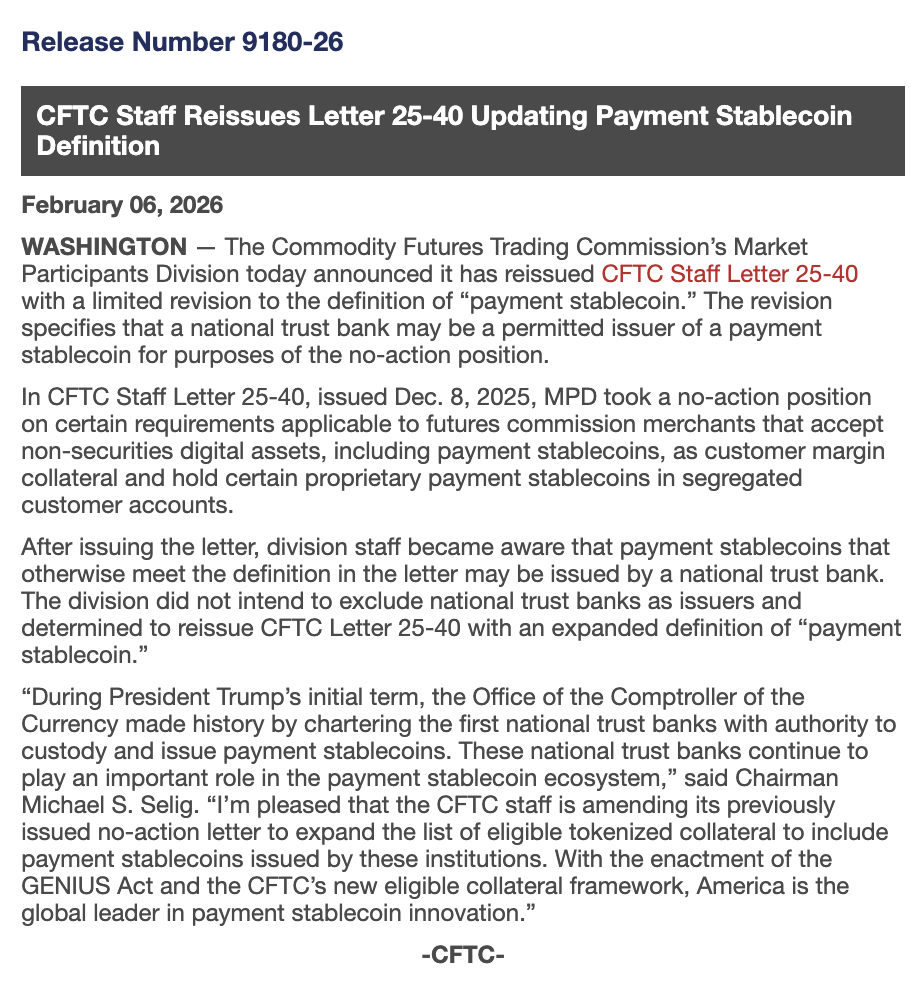
Image source: CFTC CFTC releases important guideline update, officially revising the previous staff letter to fully align with the regulatory framework established by the GENIUS Act
This change is primarily reflected in CFTC Staff Letter 26-05, which replaces and updates Staff Letter 25-40 issued on December 8, 2025. The CFTC Market Participants Division admits in the document that, in the provisions of Staff Letter 25-40, there was no intention to exclude National Trust Banks from being issuers of payment stablecoins. To correct this definitional oversight, the division decided to reissue the letter and, by expanding the definition of stablecoin issuers, formally include institutions like National Trust Banks that operate nationwide. This means that these banks, focused on asset management and custodial services, will play a more critical role in the U.S. dollar stablecoin market in the future.
Analysis of National Trust Banks’ Functions and the Background of the GENIUS Act
National Trust Banks hold a special position in the U.S. financial landscape. Unlike well-known traditional commercial banks, National Trust Banks typically do not offer general retail banking services such as personal loans or checking accounts. Their core business mainly focuses on three areas:
- Providing custody services for digital and traditional assets;
- Executing wills and estate matters on behalf of clients;
- Offering professional asset management services.
Although they do not have retail banking functions, National Trust Banks are legally authorized to operate across all 50 U.S. states, giving them natural geographic and legal advantages in cross-state stablecoin payments and clearing systems.
This policy shift by the CFTC is seen as a key follow-up after President Trump signed the GENIUS Act in July 2025. The act established the first comprehensive regulatory framework for U.S. dollar stablecoins. It clarifies the legal status of stablecoins as blockchain tokens pegged to the U.S. dollar and requires all issuance activities to be conducted under strict federal supervision. The CFTC guideline revision aims to ensure that different types of banking institutions have clear and consistent operational bases under this framework.
FDIC Proposal for Commercial Bank Participation Pathway with Strict Collateral Standards
In addition to the CFTC’s revisions concerning trust banks, the Federal Deposit Insurance Corporation (FDIC) proposed a framework for commercial banks issuing stablecoins in December 2025. According to this proposal, traditional commercial banks are permitted to issue stablecoins through their FDIC-regulated subsidiaries. Before the official launch, the FDIC will conduct rigorous compliance reviews of the parent banks and their subsidiaries to assess whether they fully meet the technical and financial requirements stipulated by the GENIUS Act.
The GENIUS Act sets very high thresholds for stablecoin stability mechanisms. It mandates that approved stablecoins must adopt an over-collateralized model, ensuring a 1:1 peg with the U.S. dollar. Collateral assets are limited to cash deposits and short-term government securities, such as U.S. Treasury Bills. Additionally, issuers must establish transparent and efficient redemption policies and undergo periodic external assessments of their financial health to ensure asset safety during market volatility.
Regulatory Red Lines and Market Transformation: Excluding Algorithmic Stablecoins
While refining the issuance system, the GENIUS Act also clearly delineates red lines for the market. The framework explicitly excludes algorithmic stablecoins (Algorithmic Stablecoins) and synthetic dollars (Synthetic Dollars) from the definition of legitimate stablecoins. These tokens rely on complex software code or market trading strategies to maintain their peg to the dollar, rather than using real fiat assets for 1:1 collateral, and are considered to pose higher systemic risks, thus cannot be recognized under current federal legislation.
From the signing of the 2025 Act to the continued refinement of rules by the CFTC and FDIC in early 2026, the legal environment for the U.S. stablecoin market is undergoing a profound transformation. As regulatory boundaries are established, stablecoin issuance is shifting from early-stage tech experiments to formal financial models led by national trust banks and their commercial bank subsidiaries. This not only strengthens investor confidence but also lays a standardized legal foundation for the long-term development of U.S. dollar stablecoins in the global payment system.
Disclaimer: The information on this page may come from third parties and does not represent the views or opinions of Gate. The content displayed on this page is for reference only and does not constitute any financial, investment, or legal advice. Gate does not guarantee the accuracy or completeness of the information and shall not be liable for any losses arising from the use of this information. Virtual asset investments carry high risks and are subject to significant price volatility. You may lose all of your invested principal. Please fully understand the relevant risks and make prudent decisions based on your own financial situation and risk tolerance. For details, please refer to
Disclaimer.
Related Articles
Polymarket's $1.5 Billion Betting Market Sparks Controversy: Israeli Journalist Faces Death Threats, Prediction Market Manipulation Risks Exposed
Polymarket platform sparked public controversy after an Israeli journalist reported on Iran's missile attacks. The journalist faced threats demanding modification of the report, raising concerns about market manipulation and information interference. This incident reveals structural risks inherent in prediction markets, underscores the urgent need to protect media independence, and highlights challenges regarding transparency and regulatory compliance.
GateNews3m ago
Is Betting Morally Corrupt? Polymarket Bettor Contacts Israeli Journalist: If You Don't Change the Article, We'll Kill You
A reporter covering Iran's missile attack on Israel received death threats from Polymarket bettors who aimed to force him to modify his reporting to influence betting outcomes. The incident has sparked discussions about the ethics of prediction markets, and the United States has proposed legislation to ban related bets. Police have opened an investigation into the threats.
CryptoCity35m ago
Argentina Moves to Restrict Polymarket, Calls It Illegal Gambling
Argentina has blocked access to the crypto prediction platform Polymarket after a court ruled it operates as unlicensed gambling, indicating heightened regulatory scrutiny of such services amid increasing digital asset adoption.
TodayqNews51m ago
SEC's Crypto Stance Takes Major U-Turn, DeFi Lobbying Group Withdraws Airdrop Lawsuit
Beba in Texas and the DeFi Education Fund withdrew their lawsuit against the SEC following improvements in the SEC's policy environment, including Commissioner Pierce's statement that free airdrops do not constitute securities. The withdrawal demonstrates a positive response to the SEC's new policies while preserving the right to refile in the future.
MarketWhisper52m ago
DeFi Lobbying Group Withdraws Airdrop Lawsuit Against US SEC, Citing Changed Regulatory Landscape for Crypto Industry
Texas apparel company Beba and DeFi Education Fund voluntarily withdrew their lawsuit against the U.S. SEC, as statements from the SEC's crypto task force and Commissioner Peirce may influence regulatory treatment of airdrops. The withdrawal preserves the right to refile the case in the future.
GateNews1h ago
Argentina Orders Polymarket Blockade, Accurate Inflation Predictions Suspected of Insider Trading
Argentina has blocked the prediction market platform Polymarket, citing unusual market reversals that occurred before official inflation data releases, which raised insider trading concerns. A court ordered internet service providers to execute the block, bringing the number of countries restricting the platform to over 30. The legal basis for the block involves consumer protection and gambling regulation issues.
MarketWhisper2h ago


